
Injection molding
Thermal spraying, in simple terms, is a technique that "puts armor" on the surface of metal equipment or parts.
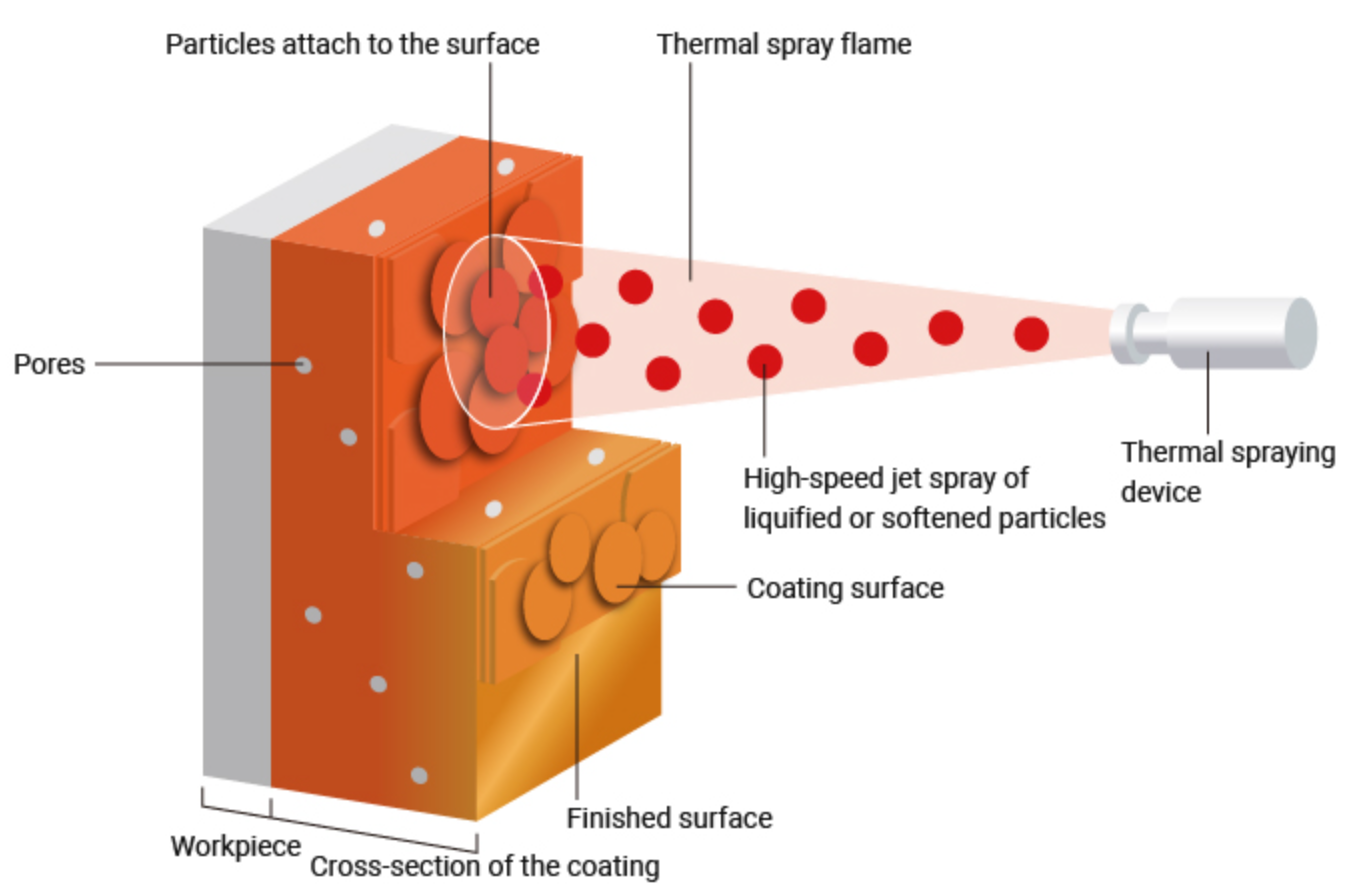
Its principle: Using a special "spray gun", through flames, electric arcs, etc., to generate high temperatures, heating the desired metals, ceramics, etc. to the molten state, and then spraying them at high speed through an air stream onto the surface of the parts. These tiny molten particles will be flattened, cooled, and piled up upon impact, eventually forming a solid coating.
The core value of this "armor" lies in: with very low costs, it enables the surface of ordinary materials to possess the high performance of expensive materials.
🎯What practical problems can it solve?
In mold processing and plastic mass production, it mainly helps you solve the following problems:
• "Longevity" and "repair" of molds
o Improve wear resistance: Spraying tungsten carbide and other super-hard materials in areas prone to wear on the mold can significantly improve
the wear resistance of the mold and extend its service life.
o Repair scrapped molds: When a mold has local wear, it can be repaired by thermal spraying and then reprocessed to restore accuracy to avoid the
high cost of overall scrapping.
• Improving the efficiency and quality of injection molding production
o Realize "non-destructive demolding": Spraying specific materials (such as a coating containing polytetrafluoroethylene) on the surface of the mold
cavity can achieve excellent self-lubrication and non-stick properties, making it easier for injection molded parts to be demolded, thereby reducing the
defect rate.
o Solve the problem of trapped air: In areas with poor air circulation, by spraying a porous breathable steel coating, it can act as a miniature exhaust
channel, solving defects such as burning and material shortage caused by trapped air in injection molded parts.
📝How is the operation process?
The entire process is usually divided into three steps:
1. Surface pre-treatment: This is the most crucial step. The surface of the part needs to be thoroughly cleaned and "roughened" using sandblasting or other methods. This allows the molten particles to better "lock" onto the substrate, ensuring a firm coating bond.
2. Spraying: Professional technicians conduct spraying operations in a dedicated spraying room, selecting appropriate process parameters based on the coating material requirements.
3. Post-coating treatment: After spraying, according to requirements, subsequent processing is carried out. For example, for anti-corrosion coatings, "sealing" treatment is carried out to prevent corrosive media from penetrating; for precision mating surfaces, grinding and fine processing are carried out.
In summary, thermal spraying is a very flexible and practical "addition and subtraction" technology. You can "add reinforcing layers" to high-end molds or "supplement missing parts" for worn-out old parts. It is one of the effective means to achieve equipment longevity and high product yield.

0086 0755 23170739
0086-0755-24325235
ciky@hainamould.com
Room 1605, 16th Floor, Hongyu Building, No. 495, Donghuan 2nd Road, Longhua Subdistrict, Longhua District, Shenzhen, Gongdong ,China 518109


Copyright 2026 Hainamould.com All rights reserved.
-
 0086 0755 23170739
-
 Facebook
-
 WhatsApp
-
 LinkedIn
-
 TOP
TOP