

Company News
In the mold industry, "timely delivery" is the gold standard for evaluating a factory's overall strength. However, late delivery has become a common problem in the industry. Even mold factories with strong technical capabilities often fall into the following three most difficult-to-avoid technical traps.
Trap 1: DFM analysis "cuts corners" and leaves problems to the subsequent processes
Many mold delays stem from the first step - DFM not being done properly. Some factories, in order to secure orders, only provide a rough DFM report without identifying potential issues such as mold release interference, insufficient strength of thin steel, or excessive wall thickness changes. As a result, halfway through the mold production, during the test run, it is discovered that the product cannot be removed or is severely deformed after being ejected.
Of course, working in this industry is also very challenging. Customers usually compare multiple options, and a detailed DFM report may require a team to spend 3 days or more. But in the end, they may not choose your factory. When I first entered this industry, I told our boss, "This is very unfair. We wasted so much time and customers still didn't choose us." But his response left a deep impression on me. He said, "Regardless of whether this order can be completed in the end, we must provide the best service to the customers. If you don't even do the job properly, why should the customer choose you? " This has been my consistent over the years, and I have cultivated the Hainan team from the very beginning to identify problems promptly and communicate with the customers when doing DFM reports. This can also avoid subsequent problems during the test run.
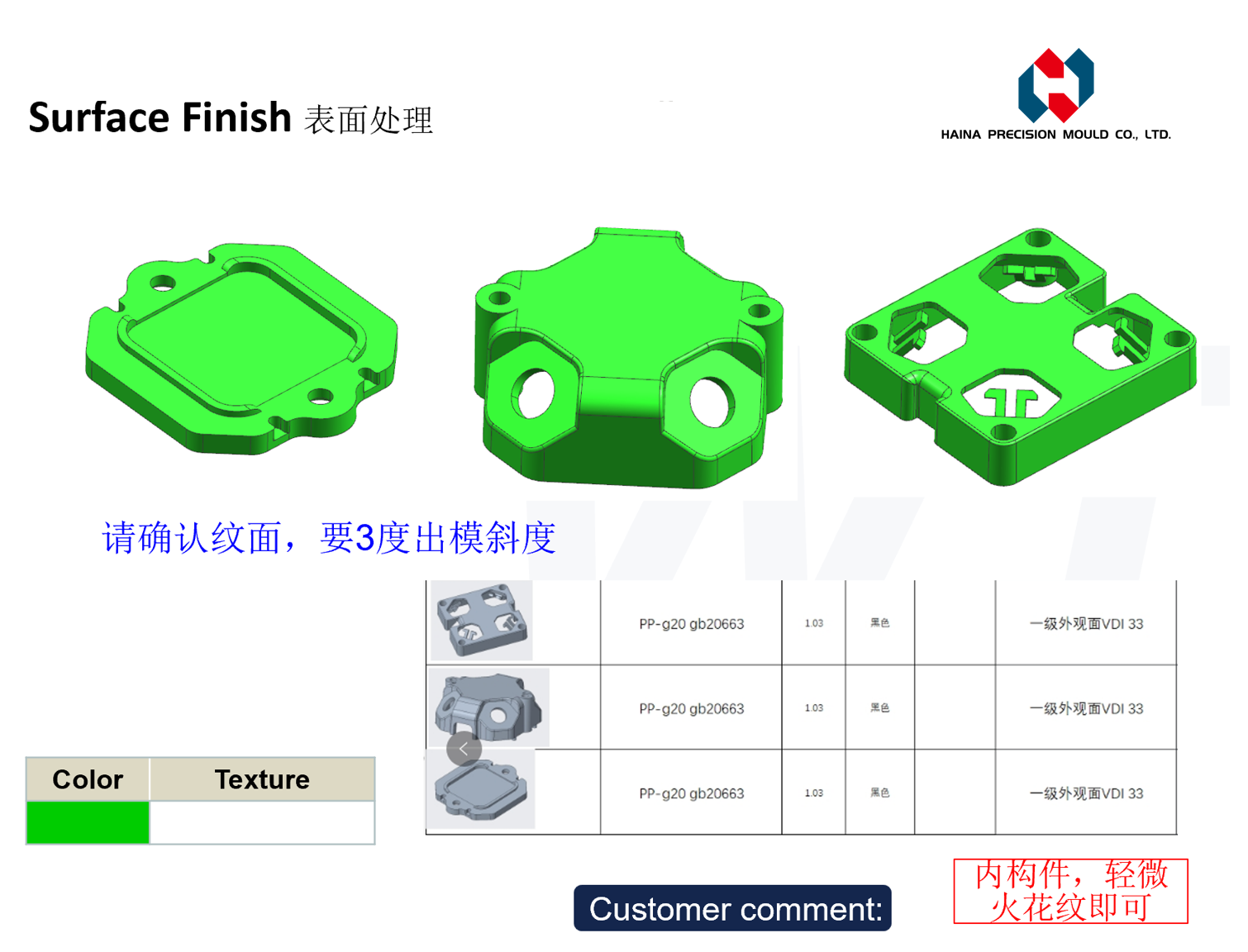
Haina's DFM reports
Trap 2: Mold flow analysis "is just a formality", unreasonable gate and cooling design
This is the most common and most concealed reason among technical delays.
If the mold flow analysis is just a formality and does not precisely simulate the behavior of the molten material, it is prone to two fatal problems:
• Incorrect gate position: causing the weld line to appear in the stressed area, trapping air that cannot be released, or failing to transfer the
holding pressure to the far end, resulting in shrinkage, warping of the product.
• Unbalanced cooling water channels: excessive temperature difference in a local area (over 15-20°C), uneven cooling contraction of the product,
and excessive deformation. Subsequently, the mold can only be repaired and the process adjusted repeatedly, with the number of test runs
soaring from the normal 3-4 times to 8-10 times.
Each additional test run means the mold needs to be re-set and adjusted for parameters, injection, measurement, and mold repair. Each cycle takes 2-3 days, and repeated over several weeks can consume a lot of time. Some factories without a dedicated test department may even outsource it to another company. This will also cost a lot of money and affect the quality of the mold.
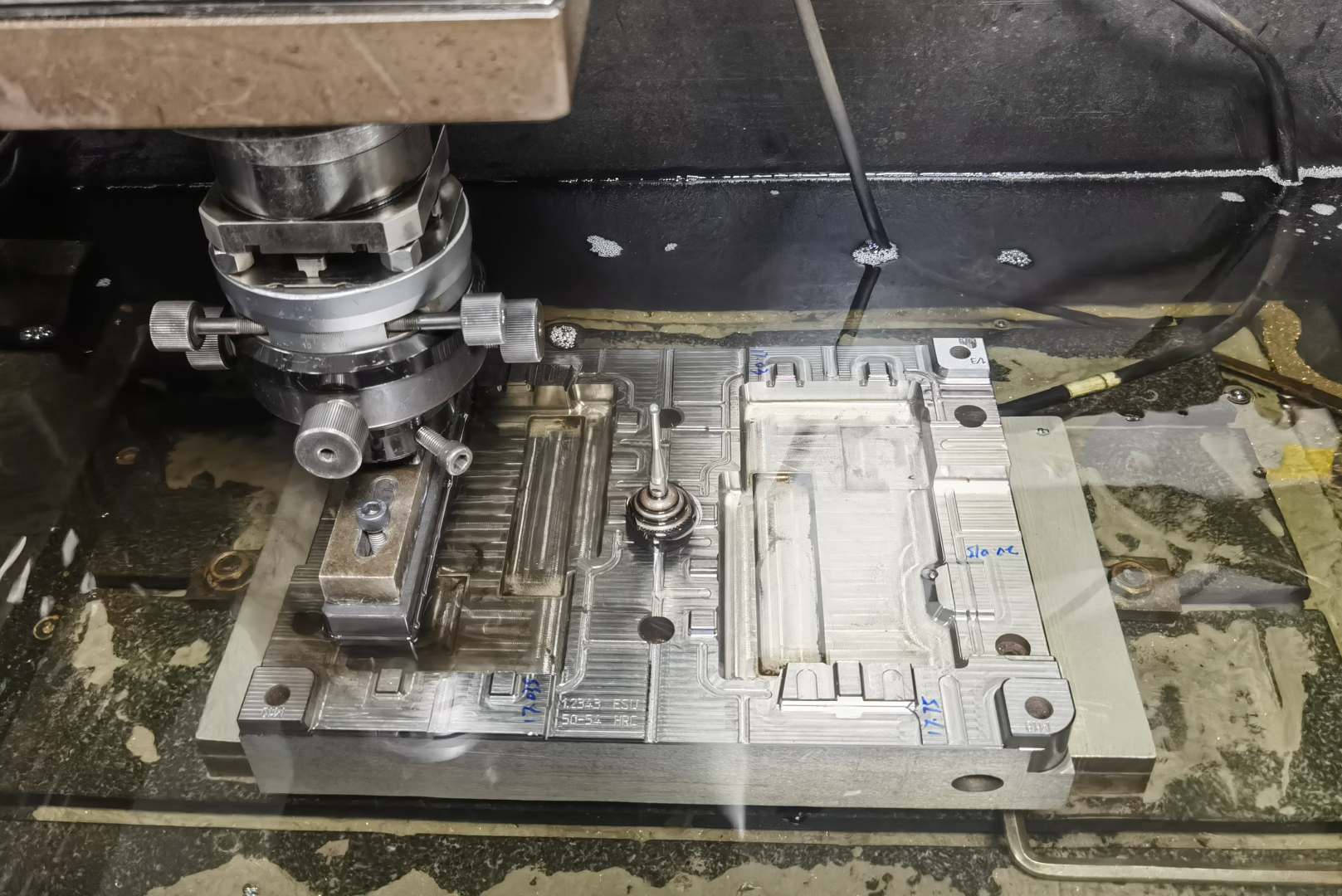
Trap 3: Insufficient processing capacity and precision, resulting in "inability to assemble" of parts
Molds are typical "high-precision assemblies" - consisting of dozens or even hundreds of parts, which ultimately need to be assembled by the hands of a fitter. If the processing accuracy at the front end is out of control, the fitter assembly stage will become a nightmare.
Common scenarios include:
• Not inspecting after CNC processing: The electrode or mold core size is out of tolerance, causing the cavity position to shift after discharge
machining. When the fitter attempts to assemble, they find that the insertion and contact points do not align, and can only manually polish and
adjust, which may take an entire day for one position.
• No reserved allowance for heat treatment deformation: The mold core undergoes heat treatment deformation, but the processing allowance is
not sufficient, making it impossible to align with the grinding machine for leveling, and having to reduce the surface or even scrap and redo.
• Insufficient equipment precision: Parts processed by old machines have non-uniform positioning reference surfaces and design reference surfaces,
resulting in cumulative errors that cause the screw holes not to align during assembly and the presser plate to get stuck.
The common feature of these problems is that the later the problem is exposed, the higher the remediation cost and the greater the time loss. By the fitter assembly stage, it is discovered that all the time spent in the previous processes was wasted.
Summary: The technical delay is essentially due to insufficient "prediction ability"
For the mold purchasing party, to determine whether a mold factory will experience a technical delay, you can ask the following three questions:
1. What contents are usually included in your DFM report? Are you willing to point out potential risks in the product design before opening the mold?
2. Who is conducting the mold flow analysis? Is it just a formality or can it guide the actual gating and cooling design?
3. Is there process control over key dimensions? Is the finished product directly sent for clamping and assembly, or is it first subjected to a three-coordinate measurement?
A mold factory that can clearly answer these three questions is qualified to discuss "timely delivery".
If you have the design drawings of your product, you can contact us at Haina Mold to have them analyzed for you. We welcome you to ask us any questions. (https://www.hainamould.com/ )

0086 0755 23170739
0086-0755-24325235
ciky@hainamould.com
Room 1605, 16th Floor, Hongyu Building, No. 495, Donghuan 2nd Road, Longhua Subdistrict, Longhua District, Shenzhen, Gongdong ,China 518109


Copyright 2026 Hainamould.com All rights reserved.
-
 0086 0755 23170739
-
 Facebook
-
 WhatsApp
-
 LinkedIn
-
 TOP
TOP