

Company News
What does a grinding machine do?
Simply put, the CNC is responsible for "creating the shape," while the grinding machine is responsible for "achieving precise dimensions and a smooth surface."
After mold components go through heat treatment and CNC machining, the surface is rough and the precision is insufficient for direct assembly. The grinding machine's task is to remove an extremely thin layer (typically measured in 0.001mm increments) from the workpiece surface using a high-speed rotating grinding wheel, ultimately achieving the flatness, surface finish, and fit accuracy required by the drawing.
Three Core Applications:
Surface Grinding: Grinds the reference surfaces of mold plates and cores flat, ensuring flatness within 0.005mm, providing a reliable benchmark for all subsequent machining operations.
Form Grinding: Machines small features that CNC struggles with, such as precision punch outer diameters, R-corners, and angled surfaces, achieving accuracy up to 0.002mm.
Thin Part Grinding: Processes thin, easily deformable components (such as precision shims), a task that conventional milling machines find very difficult.
Why is it indispensable?
Without a grinding machine, mold components either won't fit together during assembly or will be too loose; product surfaces are prone to flash or burrs. It can be said that the grinding machine directly determines the fit precision and service life of the mold.
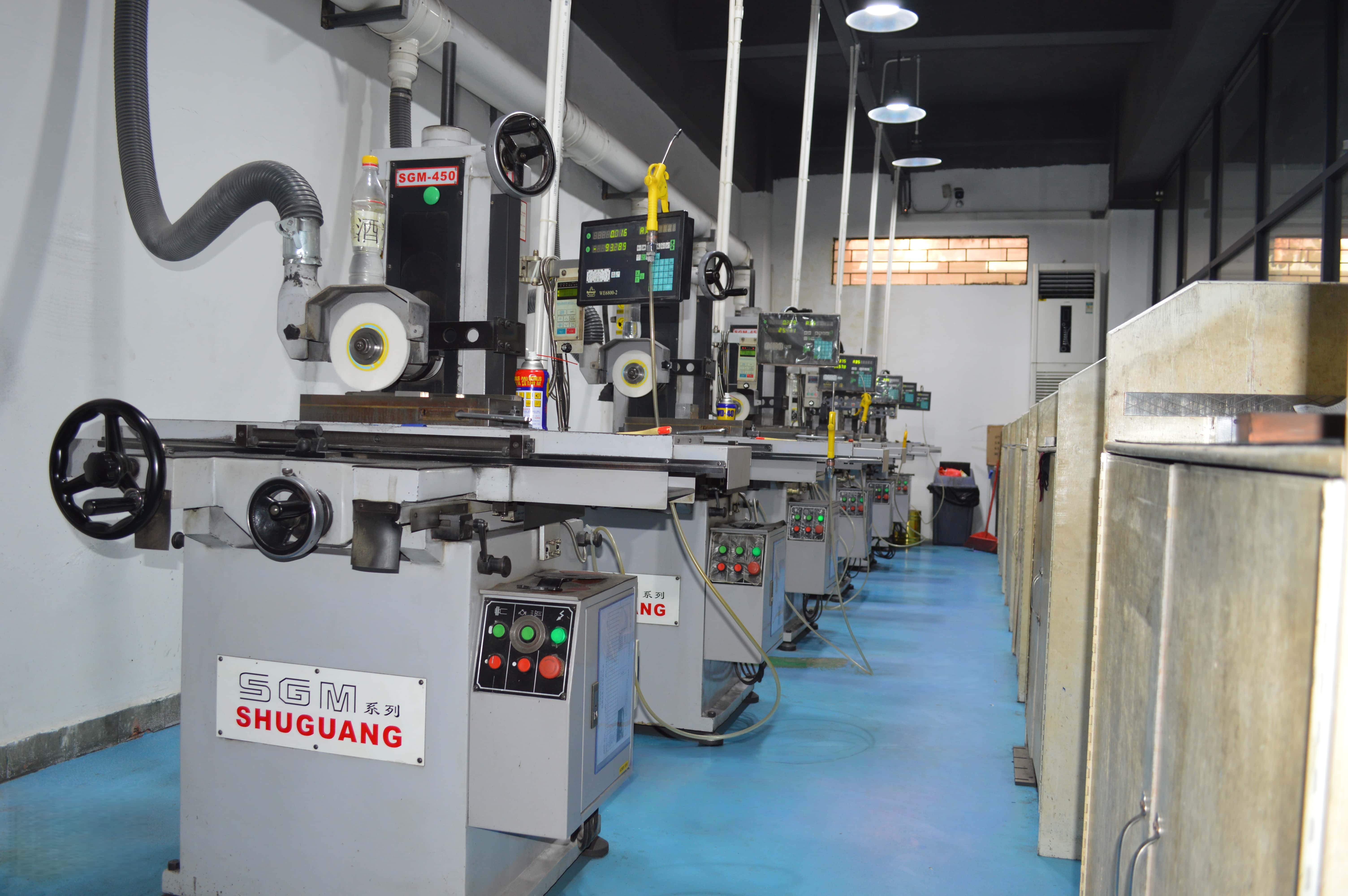
Haina's Grinding machine workshop
Workshop vedio: https://youtube.com/shorts/iJVKjPROGk4

0086 0755 23170739
0086-0755-24325235
ciky@hainamould.com
Room 1605, 16th Floor, Hongyu Building, No. 495, Donghuan 2nd Road, Longhua Subdistrict, Longhua District, Shenzhen, Gongdong ,China 518109


Copyright 2026 Hainamould.com All rights reserved.
-
 0086 0755 23170739
-
 Facebook
-
 WhatsApp
-
 LinkedIn
-
 TOP
TOP