

Injection molding
In injection molding, a wall thickness of 28mm far exceeds the conventional range and falls firmly into the category of thick-wall molding. Shrinkage — a persistent industry headache — is magnified many times over in thick-wall parts, making it one of the most formidable challenges in production.
The root cause of shrinkage is straightforward: the outer layer cools and solidifies first, while the inner layer cools and shrinks later. With no sufficient melt supply to compensate for the shrinkage, the surface develops sink marks, and voids may form internally. The greater the cooling time differential, the more severe the shrinkage becomes.
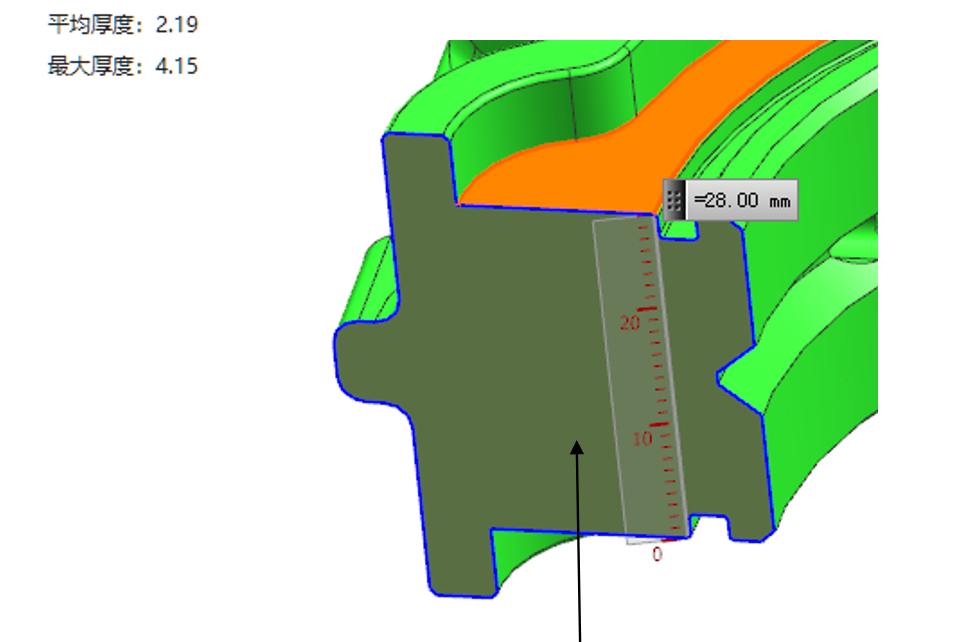
Addressing this issue requires a coordinated effort across three fronts: design, tooling, and process.
On the design front, reducing wall thickness at the source is the most fundamental solution. By incorporating ribs or optimizing the structural design, wall thickness can be reduced while maintaining strength, thereby narrowing the temperature differential between the outer and inner layers. If a hollow thick-wall structure can be achieved, the shrinkage problem is essentially eliminated.
On the tooling front, the key is to keep the feeding channel open for effective packing. Positioning the gate in the thick-wall area and enlarging its dimensions helps delay gate freeze-off, allowing melt to continue feeding during the packing phase. At the same time, cooling channels should be densified around the thick-wall section and the venting system optimized to ensure smooth melt filling. For 28mm wall thickness, gas-assisted injection molding offers a more radical solution — by injecting high-pressure nitrogen to create a hollow structure inside the thick wall, the thick wall is effectively "converted" into a thin wall, and shrinkage ceases to be an issue.
On the process front, extending packing time is the most direct lever for controlling shrinkage. The golden rule is to ensure that the gate does not freeze off before packing is completed. In addition, appropriately shortening the cooling time and ejecting the part at a higher temperature can promote more uniform overall shrinkage. Mold temperature should not be set too high, as rapid solidification of the skin layer helps resist the pulling force from internal shrinkage.
When 28mm thickness is paired with demanding precision requirements, multi-layer injection molding offers a new alternative — by breaking the thick wall into two or more layers molded sequentially, each layer returns to a conventional thickness range, and the shrinkage problem is naturally alleviated.
The battle against shrinkage in thick-wall injection molding appears on the surface to be a matter of process optimization, but in essence, it is a systematic engineering challenge that requires synergy between design and manufacturing. From source thinning to gas assistance, from extended packing to multi-layer molding, every solution circles back to the same question: how do we eliminate shrinkage while preserving wall thickness? The answer is gradually taking shape through the industry's ongoing exploration of new technologies.

0086 0755 23170739
0086-0755-24325235
ciky@hainamould.com
Room 1605, 16th Floor, Hongyu Building, No. 495, Donghuan 2nd Road, Longhua Subdistrict, Longhua District, Shenzhen, Gongdong ,China 518109


Copyright 2026 Hainamould.com All rights reserved.
-
 0086 0755 23170739
-
 Facebook
-
 WhatsApp
-
 LinkedIn
-
 TOP
TOP