
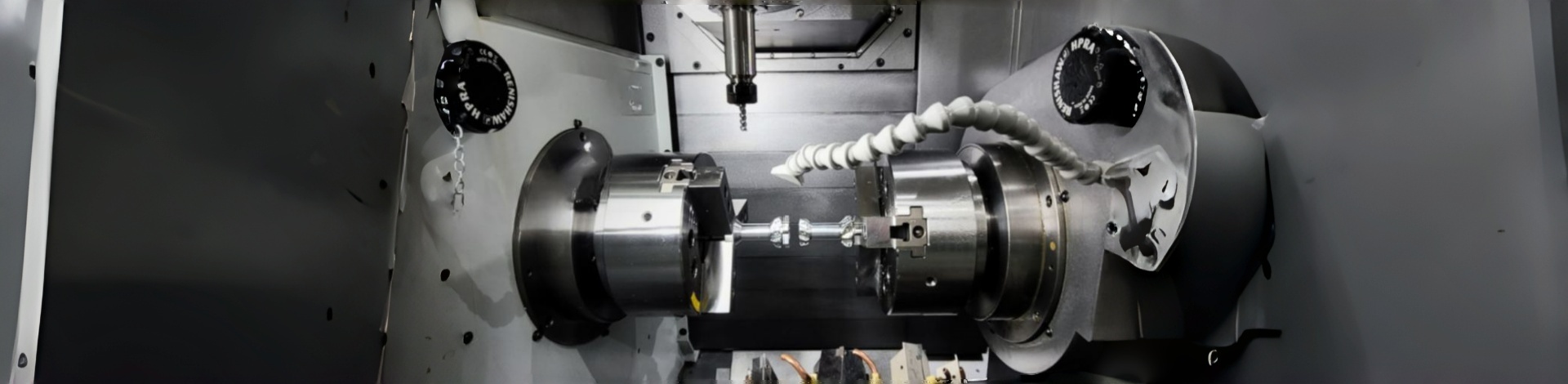
CNC Machining
Deformation during thin-walled part machining is one of the most troublesome issues in CNC machining. With wall thicknesses of only one or two millimeters, you dare not apply too much force when clamping, and the tool vibrates as soon as it cuts. The finished parts either end up out of tolerance or get scrapped outright.
To control deformation, you need to start from three aspects: fixturing, tooling, and cutting strategy.
1. Fixturing: Keep the workpiece "standing steady"
Thin-walled parts are most afraid of clamping deformation. Clamp too tight, and they spring back when released, making dimensions inaccurate. Clamp too loose, and they shift during milling.
·Use soft jaws or custom fixtures: Don't use hard jaws directly. Switch to soft jaws (aluminum or copper jaws), or make a contour-following fixture that "wraps" around the entire workpiece to distribute clamping force.
·Add auxiliary support: Place support blocks or shims behind thin-walled sections to reduce force-induced deformation.
·Reduce clamping force: Don't use brute force—just enough to hold it. If it can be tightened by hand, don't crank it down with a wrench.
·Rough then finish, with separate clamping: Leave stock during roughing, release to relieve stress, then finish to final dimensions.
2. Tooling and cutting parameters: Make the cut "lighter"
The main cause of deformation is excessive cutting force that "pushes" the workpiece out of shape. The key is "light cutting."
·Use sharp tools: Tools with large rake angles and sharp edges generate less cutting force. Aluminum-specific end mills with polished flutes are recommended.
·Increase speed, reduce feed: High spindle speed, shallow depth of cut, and moderate feed rate—let the tool "scrape" rather than "gnaw."
·Use climb milling: With climb milling, the cutting force pushes downward, which is more favorable for thin-walled parts. Conventional milling lifts upward and tends to pull the thin wall up.
·Take multiple depth passes, don't cut it all in one pass: Break large stock removal into several passes, taking 0.3–0.5mm per pass—much safer than taking a 2mm cut in one go.
·Keep tool overhang as short as possible: The longer the tool sticks out, the worse the rigidity and the more severe the chatter. Keep it as short as you can.
3. Toolpath strategy: Let heat and stress "dissipate"
·Don't mill continuously in one spot: Alternate between different areas to give the workpiece time to dissipate heat and release stress.
·Retract quickly during rapid moves: Reduce friction heat generated when the tool moves without cutting.
·Ensure adequate cooling: Cutting fluid must reach the cutting zone, especially in deep cavities and narrow slots. If possible, oil mist cooling works even better.
·Add temporary stiffening ribs when necessary: Add a few temporary ribs between thin walls, then cut them off after machining—it's like "putting a cast on the workpiece."
Summary
To control deformation in thin-walled parts, follow the three principles of light, stable, and even. With this approach, you can control most of the deformation.
If your thin-walled parts are experiencing deformation issues during machining, or if you're looking for an experienced shop that can get thin-walled parts done right, feel free to reach out to Haina for a chat.
📧 Email: ciky@hainamould.com
🌐 Website: https://www.hainamould.com/Contactus/SendMessage
👉 Submit Your Drawings for a Free Technical Evaluation and Quote
(Please upload your 3D/2D drawings, material specifications, estimated quantity, and delivery requirements. We will respond within 24 hours.)

0086 0755 23170739
0086-0755-24325235
ciky@hainamould.com
Room 1605, 16th Floor, Hongyu Building, No. 495, Donghuan 2nd Road, Longhua Subdistrict, Longhua District, Shenzhen, Gongdong ,China 518109


Copyright 2026 Hainamould.com All rights reserved.
-
 0086 0755 23170739
-
 Facebook
-
 WhatsApp
-
 LinkedIn
-
 TOP
TOP