Injection molding
Additive manufacturing, commonly known as 3D printing, is a process that builds objects by adding material layer by layer, from the bottom up. This is fundamentally different from traditional CNC machining, which removes material from a solid block.
The basic principle is simple: a 3D model is sliced into numerous thin layers, and material is then deposited or solidified layer by layer until a complete solid object is formed.
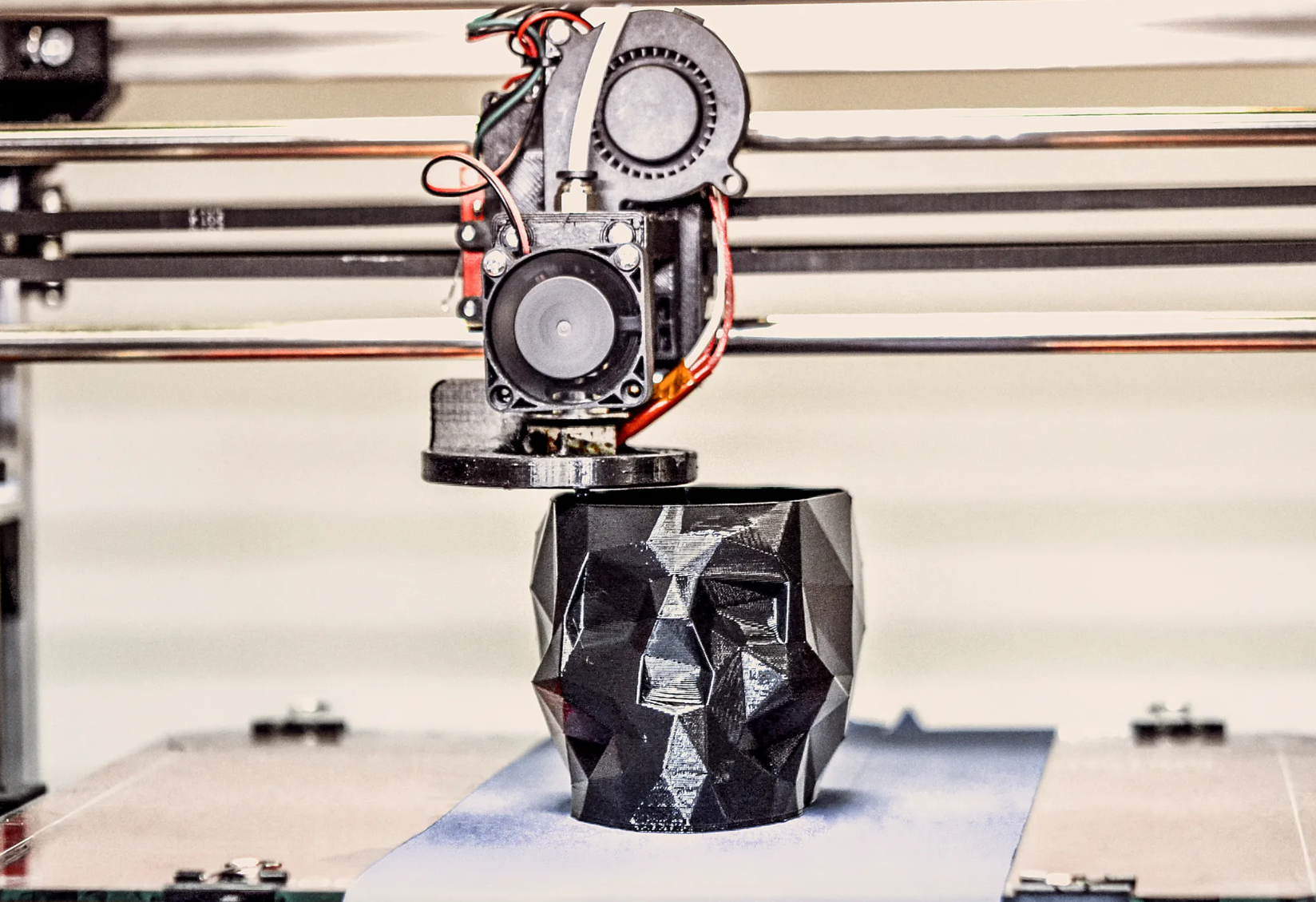
Additive manufacturing is not a single technology, but a broad category of processes. Common types include Fused Deposition Modeling (FDM), which extrudes heated plastic filament and is the most cost-effective option for prototype validation; Stereolithography (SLA), which cures liquid resin with UV light for high precision and smooth surfaces; Selective Laser Sintering (SLS), which uses a laser to sinter nylon powder for strong, functional test parts; and metal additive manufacturing (SLM), which melts metal powder with a laser to produce metal parts directly.
In the mold industry, the most important application of additive manufacturing is conformal cooling channels. While traditional CNC machining can only produce straight cooling channels, 3D printing enables curved channels that follow the shape of the product, resulting in more uniform cooling, shorter cycle times, and more consistent quality. It is also used for rapid prototyping, complex mold inserts, and small-batch production.
The advantages of additive manufacturing include high material utilization, virtually unlimited geometric freedom, and suitability for small batches and rapid validation. However, it also has limitations — it is less efficient than traditional processes for high-volume production, and the range of available materials is relatively limited.
Simply put, additive manufacturing is a "building-up" approach to manufacturing. It does not replace traditional processes, but rather offers a solution that is difficult or impossible to achieve with conventional methods — especially for complex geometries, rapid validation, and small-batch production.

0086 0755 23170739
0086-0755-24325235
ciky@hainamould.com
Room 1605, 16th Floor, Hongyu Building, No. 495, Donghuan 2nd Road, Longhua Subdistrict, Longhua District, Shenzhen, Gongdong ,China 518109


Copyright 2026 Hainamould.com All rights reserved.
-
 0086 0755 23170739
-
 Facebook
-
 WhatsApp
-
 LinkedIn
-
 TOP
TOP