

Injection molding
Many people, upon seeing a plastic injection mold for the first time, think it's just a heavy block of metal. In reality, it is a precision assembly made of multiple steel plates stacked together, with the cavity that determines the product's shape and the cooling channels for heat dissipation hidden inside.
When in operation, the mold is mounted on an injection molding machine. Molten plastic is injected under high pressure into the cavity inside the mold. After cooling and solidifying, the mold opens and the product is ejected. What the final product looks like and how accurate its dimensions are is entirely determined by the core part inside the mold.
Front Mold and Rear Mold
The mold is divided into two main parts: the front mold and the rear mold.
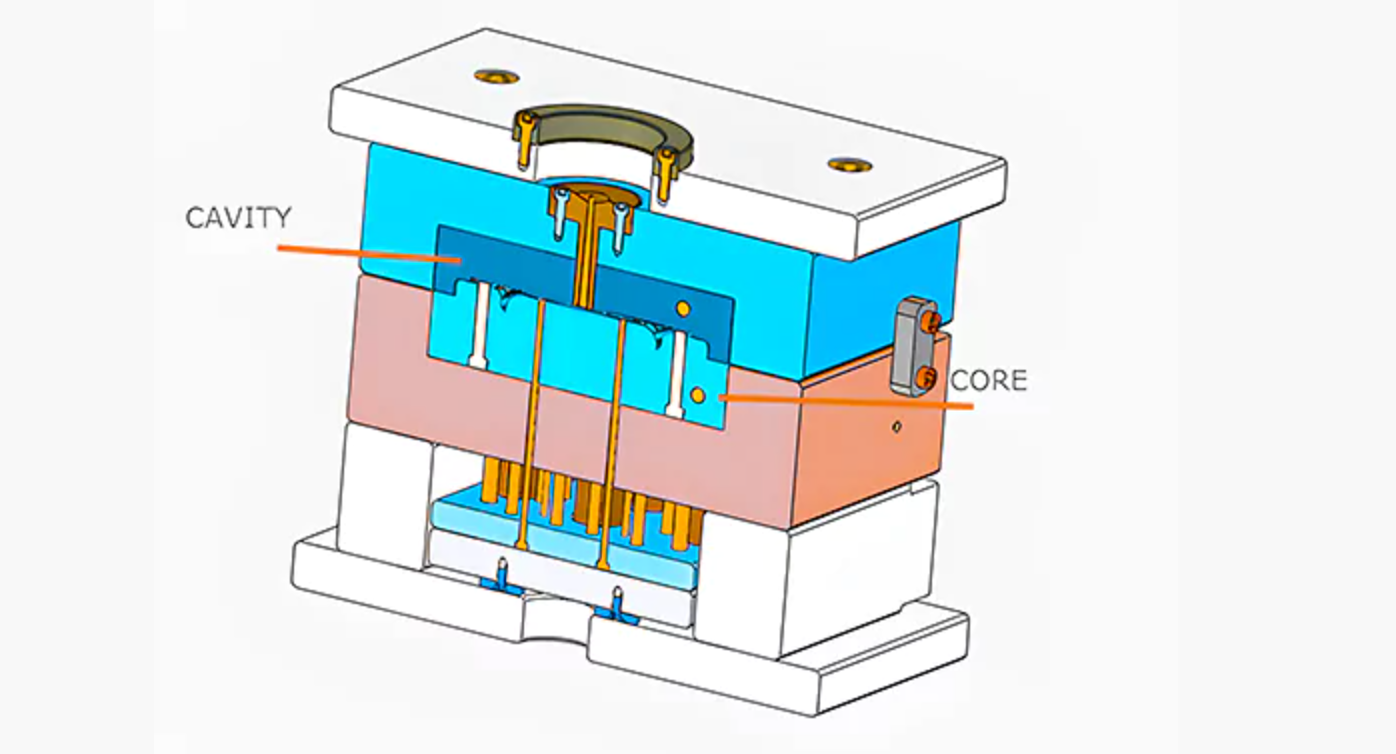
The front mold, also called the stationary mold, is the side fixed to the injection molding machine and does not move. It is usually connected to the injection nozzle, and this is where the molten plastic enters the mold.
The rear mold, also called the moving mold, is the side that moves back and forth with the machine's opening and closing action. After the product cools, the mold opens, the rear mold retracts, and the product typically stays on the rear mold side, where it is then ejected by the ejection system.
When the front mold and rear mold come together, the gap between them forms the shape of the product. This gap consists of two parts: the cavity determines the outer surface of the product, and the core determines the inner surface.
Mold Base and Mold Insert
A mold can be simply understood as two main parts: the mold base and the mold insert.
The mold base is essentially the skeleton of the mold. It is a frame structure made of multiple steel plates stacked together, including the top clamp plate, A plate, B plate, spacer blocks, bottom plate, and so on. The mold base's role is to secure and support the various systems of the mold, while also providing basic functions such as guidance and ejection. Mold bases are usually standard components that can be purchased directly or customized as needed.
The mold insert is the core part that actually does the work — the cavity and core mentioned earlier. It is embedded in the A plate and B plate of the mold base, comes into direct contact with the plastic, and determines the final shape, dimensions, and appearance of the product. The mold insert must be machined individually according to the product drawings, with extremely high precision requirements. It is the most labor-intensive and most critical component of the entire mold.
To use an analogy: the mold base is like the frame and walls of a house, while the mold insert is the core area that actually determines the layout and function. The mold base provides support and structure, and the mold insert is responsible for forming.
In addition to the mold base and mold insert, the mold also includes the runner system (the channel through which plastic enters), the cooling system (circulating cooling water for heat dissipation), the ejection system (to push the product out), and the venting system (to expel air from the cavity). These systems are all mounted on the mold base and work together around the mold insert.
Summary
Simply put, a plastic injection mold is a precision metal assembly supported by the mold base and formed by the mold insert. The front mold is stationary, the rear mold opens and closes, the mold insert determines the product's shape, and the mold base provides structural support. The quality of a mold largely depends on the machining precision of the mold insert and the overall fit of the mold base.

0086 0755 23170739
0086-0755-24325235
ciky@hainamould.com
Room 1605, 16th Floor, Hongyu Building, No. 495, Donghuan 2nd Road, Longhua Subdistrict, Longhua District, Shenzhen, Gongdong ,China 518109


Copyright 2026 Hainamould.com All rights reserved.
-
 0086 0755 23170739
-
 Facebook
-
 WhatsApp
-
 LinkedIn
-
 TOP
TOP