
Industry Insights
The year is drawing to a close, and one obvious change in the current market is this: the room for growth through volume expansion and price wars is shrinking, while technological change and evolving consumer demand are rapidly reshaping the competitive landscape. For small businesses, developing new products is not just about finding incremental growth—it is a key means of building a moat and securing room to survive when resources are limited.
1. Why the Market Needs New Product Development
The old growth logic is failing. Relying solely on low-cost processing or single-market expansion is no longer sustainable. The main line of market growth is shifting toward super technologies (such as AI), consumer iteration (such as low-sugar, low-fat, high-fiber products), and global brands. —The essence of a new product is capturing a new demand gap.
For small businesses, developing new products carries an additional layer of significance: low-cost trial and error to leverage a second growth curve. Small businesses have weak risk resistance, but this is precisely their advantage—they can conduct small-scale experiments more flexibly. First use the customer trust and cash flow accumulated from the main business to validate new ideas with small orders or minimum viable products, rather than making heavy investments from the outset. Once validated, the new product becomes a buffer when the old business declines; even if it fails, the impact is relatively manageable. In addition, small businesses have short decision-making chains, and founders can immediately put new technologies or new demands into practice, establishing first-mover advantages in niche gaps that large enterprises find difficult to replicate quickly.
But from idea to mass production, a new product must cross a hurdle that is easily underestimated—manufacturing feasibility. And the key player standing at that hurdle is often the mold manufacturer.
2. What Mold Manufacturers Can Offer: Far More Than "Machining to Drawings"
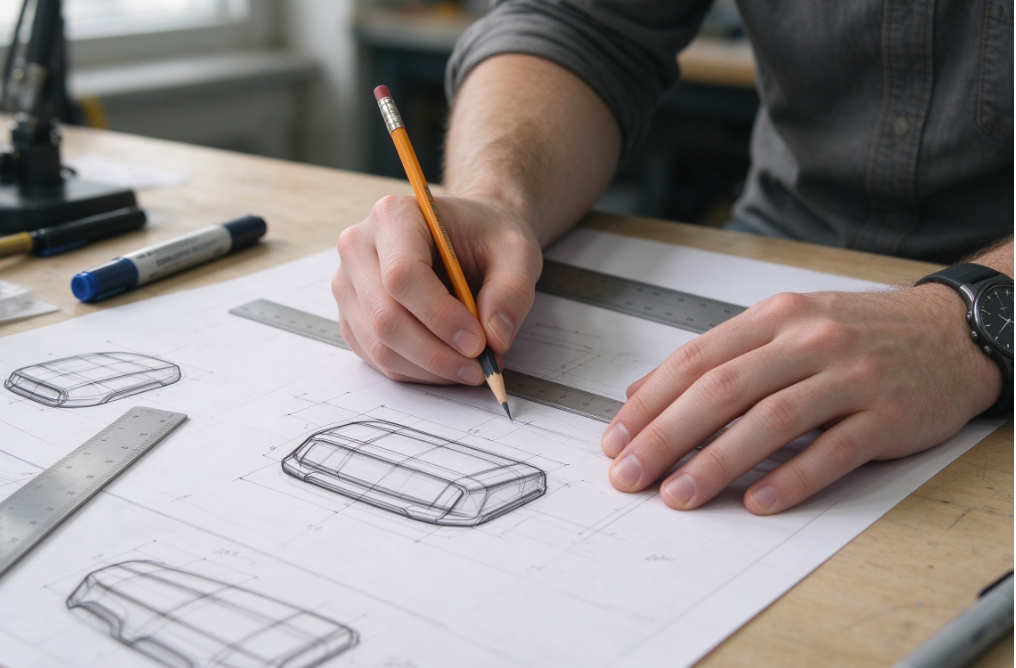
Many small businesses treat mold manufacturers as suppliers who deliver according to drawings, which actually underestimates their value. A professional mold manufacturer can fully play the role of engineering consultant and risk buffer in the early stages of product development.
Intervening at the design stage and using design for manufacturability analysis to save you money. Many new products look perfect on paper but may not be efficiently and cost-effectively manufactured. Experienced mold manufacturers provide design for manufacturability (DFM) analysis, pointing out before mold opening issues such as whether wall thickness is uniform, whether there are features that could cause shrinkage or deformation, and whether draft angles are sufficient. Without this step, if you discover only after the mold is made that qualified products cannot be produced, the cost and time losses from modifying the mold often far exceed the small adjustments made at the design stage. Some mold manufacturers also provide mold flow analysis simulation, rehearsing the plastic filling and cooling process on the computer to detect potential defects in advance. For small businesses, this early intervention is equivalent to verifying mass-production feasibility at a very small cost.
Using rapid trial molds to help you validate the market at low cost. The biggest risk for small businesses developing new products is not that they cannot make them, but that they make them and cannot sell them. Traditional mass-production molds cost tens of thousands of yuan, and if the product selection is wrong, the upfront investment is wasted. Addressing this pain point, many mold manufacturers have launched rapid trial mold or simplified mold services. For example, the "rapid mold opening" service provided by Yiwu Mold City uses lower-cost base materials and simplified processes to first make a set of small-batch trial molds, with costs potentially only a fraction of conventional mass-production molds (a few thousand yuan vs. tens of thousands of yuan), and samples can be produced within days for test sales. If market feedback is good, upgrade to a multi-cavity mass-production mold to scale capacity; if the response is lukewarm, the loss is fully controllable. This model allows small businesses to test new products in a "small steps, quick pace" manner rather than betting all resources at once.
3. How to Choose: Find a "Partner," Not Just a "Quote"
Overall, for small businesses, a suitable mold manufacturer is not just a supplier but more like an engineering partner in the product development chain. They can help make your design more manufacturable, validate the market with low-cost solutions, ease funding pressure through flexible cooperation, and accelerate the speed from idea to finished product.
Therefore, when choosing a mold manufacturer, it is worth prioritizing partners who are willing to seriously discuss design with you before mold opening, can provide trial mold solutions, and communicate smoothly—rather than the one that only compares prices. New product development is inherently an experiment that requires risk control. With a manufacturing-savvy partner on your side, the cost of trial and error will be much lower, and the confidence in completing the journey from idea to mass production will be much greater.

0086 0755 23170739
0086-0755-24325235
ciky@hainamould.com
Room 1605, 16th Floor, Hongyu Building, No. 495, Donghuan 2nd Road, Longhua Subdistrict, Longhua District, Shenzhen, Gongdong ,China 518109


Copyright 2026 Hainamould.com All rights reserved.
-
 0086 0755 23170739
-
 Facebook
-
 WhatsApp
-
 LinkedIn
-
 TOP