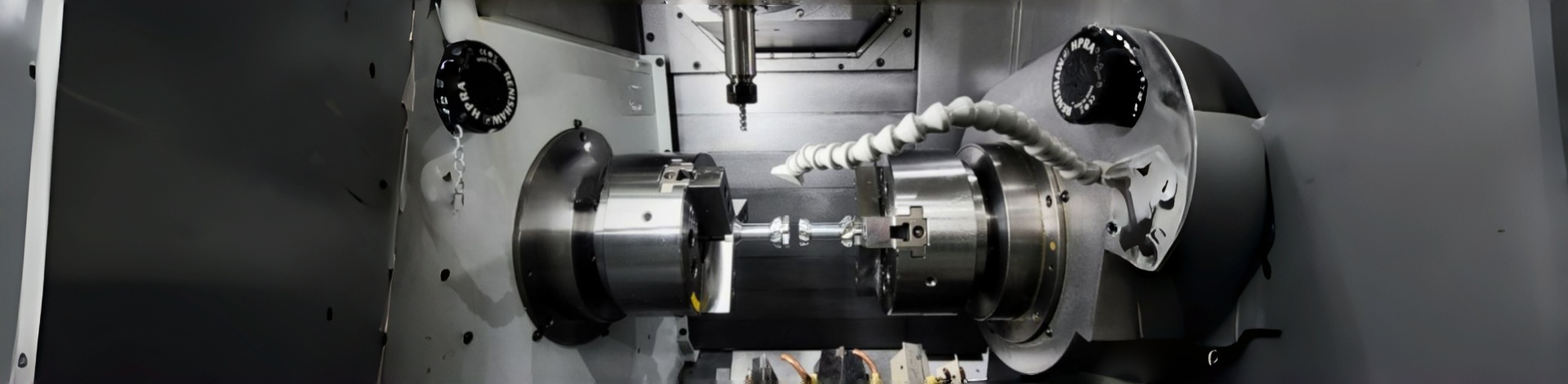
CNC Machining
In the product development process, going from a design drawing to a physical object that can be held, assembled, and dropped without breaking requires a reliable manufacturing step in between. CNC prototyping is one of the most commonly used and reliable methods for physical validation today. It is often compared with 3D printing, but CNC prototyping has clear advantages in precision, material selection, and surface finish.
1. The Basic Concept of CNC Prototyping
Simply put, CNC prototyping uses computer numerical control (CNC) machine tools to perform subtractive machining on a solid block of material—milling, turning, and drilling—gradually cutting a metal or plastic blank into the designed part shape. Because the part is carved directly out of solid material, it can use materials identical or similar to those used in final mass production, so the resulting prototype is closer to the real product in strength, temperature resistance, and feel.
2. Why It Is Needed in Product Development
ⅰ. Validating appearance and structure. CNC prototypes can achieve high-precision dimensions (typically ±0.01–0.05 mm) and fine surfaces, making them useful for checking assembly interference, ergonomic feel, and whether the appearance and texture meet expectations.
ⅱ. Functional testing. Prototypes made from real materials (such as ABS, PC, POM, and aluminum alloy) can be used for drop tests, temperature resistance tests, and threaded assembly tests—things many 3D-printed parts limited to appearance validation cannot do.
ⅲ. Small-batch trial production. Before committing to a steel mold, CNC can produce dozens to hundreds of parts in small batches for market preheating, customer samples, or trade show displays, with far less risk than opening a mold directly.
ⅳ. Validation before mold making. For injection-molded parts, CNC prototypes can verify whether the structural design is reasonable and identify problems such as uneven wall thickness or assembly difficulties in advance, avoiding modifications after the mold has been made.
3. How to Choose Between CNC Prototyping and 3D Printing
The two are not substitutes but complements:
3D printing is suitable for early concept validation of complex shapes, internal conformal cooling channels or lattice structures, and cases with low appearance precision requirements—it is fast and low-cost.
CNC prototyping is suitable for functional test parts requiring material performance, dimensional precision, and surface finish, as well as appearance validation parts that need to be close to mass-production condition. For products that will later be injection molded, CNC parts are closer to the final product in material shrinkage and assembly feel, offering higher reference value.
4. A Practical Process Reference
The typical path is: design drawing (3D model) → design for manufacturability analysis (DFM, checking whether the structure is suitable for machining) → programming (CAM) → material selection and fixturing → CNC machining → surface treatment (sanding, sandblasting, anodizing, etc.) → dimensional inspection → delivery. The DFM step is critical—identifying difficult-to-machine features such as undercuts and deep cavities in advance can avoid repeated drawing revisions and machining.
For small businesses, the significance of CNC prototyping lies in using controllable cost and shorter time to turn "ideas" into physical objects that can be touched, tested, and displayed, thereby minimizing product risk before mold opening.
5. Hainamould's CNC Machining Capabilities
When looking for a CNC prototyping supplier, equipment precision and engineering experience directly determine the quality of the prototype. Hainamould's CNC programming and operating team has extensive experience in five-axis/high-speed machining, with key dimensions controlled within ±0.01 mm.
Hainamould not only provides high-precision CNC prototype machining but also seamlessly connects prototype production with subsequent mold manufacturing. From DFM analysis in the early design stage to precision machining and CMM/2D coordinate dimensional inspection, Hainamould's team ensures that your design is fully validated before mold opening.
👉 To learn more about Hainamould's CNC prototyping and precision machining services, please visit:
[CNC Machining - hainamould Mould Company Limted]

0086 0755 23170739
0086-0755-24325235
ciky@hainamould.com
Room 1605, 16th Floor, Hongyu Building, No. 495, Donghuan 2nd Road, Longhua Subdistrict, Longhua District, Shenzhen, Gongdong ,China 518109


Copyright 2026 Hainamould.com All rights reserved.
-
 0086 0755 23170739
-
 Facebook
-
 WhatsApp
-
 LinkedIn
-
 TOP