
Company News
Anyone working in injection molding or 3D printing knows the headache: parts come out with layer lines or microscopic surface irregularities. If you want a high-gloss or transparent finish, the traditional approach is to have someone sand and polish the part by hand, bit by bit. But when it comes to complex curved surfaces or internal channels, human hands simply cannot reach inside—it's time-consuming, labor-intensive, and the results aren't always reliable.
A process called "vapor polishing" has been getting a lot of attention in the industry lately. It's completely different from traditional physical polishing—instead of shaving the surface down, it makes the plastic surface "flow flat" on its own.
How Does It Actually Work?
The whole process is like giving the part a "steam bath."
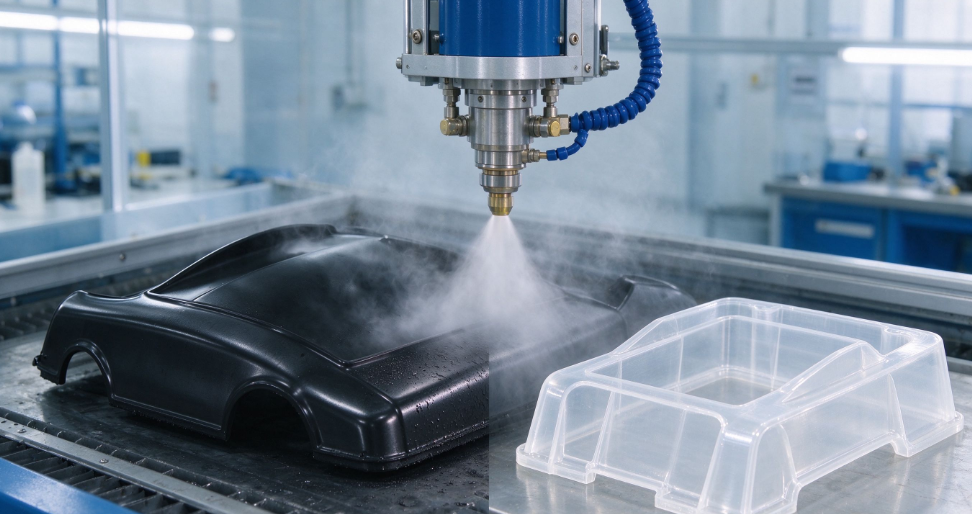
The plastic part is placed in a sealed chamber filled with heated solvent vapor (such as acetone or methylene chloride, depending on the material). The vapor condenses when it hits the part surface, softening the extremely thin outermost layer of plastic.
Under surface tension, the softened surface layer undergoes microscopic flow, filling in the rough "valleys" like a liquid while also dissolving and smoothing out the "peaks." After processing, the part is removed, the residual solvent evaporates, and the surface re-hardens. The originally rough surface ends up with what is essentially a new, smooth skin.
Which Materials Can Take This?
This trick doesn't work on all plastics—it mainly targets amorphous plastics, and the ones we encounter most in daily life are ABS, PC (polycarbonate), and acrylic (PMMA). Many of the transparent parts and high-gloss housings you've seen are well-suited to this.
Different materials need different "chemicals." For example, ABS typically uses acetone, PC commonly uses methylene chloride, and acrylic uses trichloroethylene.
The results are quite visible—surface roughness can be reduced significantly. For 3D-printed parts, the layer lines are essentially eliminated; for injection-molded parts, you can achieve a high-gloss effect close to a mirror finish.
What Should You Watch Out For?
First, it's strictly a surface treatment—it doesn't change the internal dimensions or structure of the part. But if over-processed, sharp edges may become rounded and fine textures may become blurred, so process parameters need to be carefully controlled.
Also, since chemical solvents are involved, environmental emissions and operational safety cannot be ignored—dedicated equipment and recovery systems are required.
For mold and injection molding shops, the practical value of this process is this: when your mold is already made to high precision but the part surface still falls just short—especially in dead zones that mechanical polishing cannot reach—vapor polishing is a solid remedy. No need for major mold modifications; one pass through the vapor chamber can elevate the surface quality to the next level.

0086 0755 23170739
0086-0755-24325235
ciky@hainamould.com
Room 1605, 16th Floor, Hongyu Building, No. 495, Donghuan 2nd Road, Longhua Subdistrict, Longhua District, Shenzhen, Gongdong ,China 518109


Copyright 2026 Hainamould.com All rights reserved.
-
 0086 0755 23170739
-
 Facebook
-
 WhatsApp
-
 LinkedIn
-
 TOP