CNC Machining
In the field of custom CNC precision machining, material selection often directly determines a project's final cost, lead time, and the lifespan of the product. When faced with the two most commonly used aluminum alloys—6061 and 7075—many product managers and hardware engineers often fall into the "strength-only" trap, assuming that the more expensive, higher-strength 7075 aluminum is always the better choice.
However, veteran manufacturing experts point out: In CNC machining, there is no absolute "better," only a "better match." Blindly choosing 7075 aluminum can not only drive up machining costs but also introduce unnecessary risks of machining distortion and surface treatment challenges.
The Trade-off Between Strength and Machinability
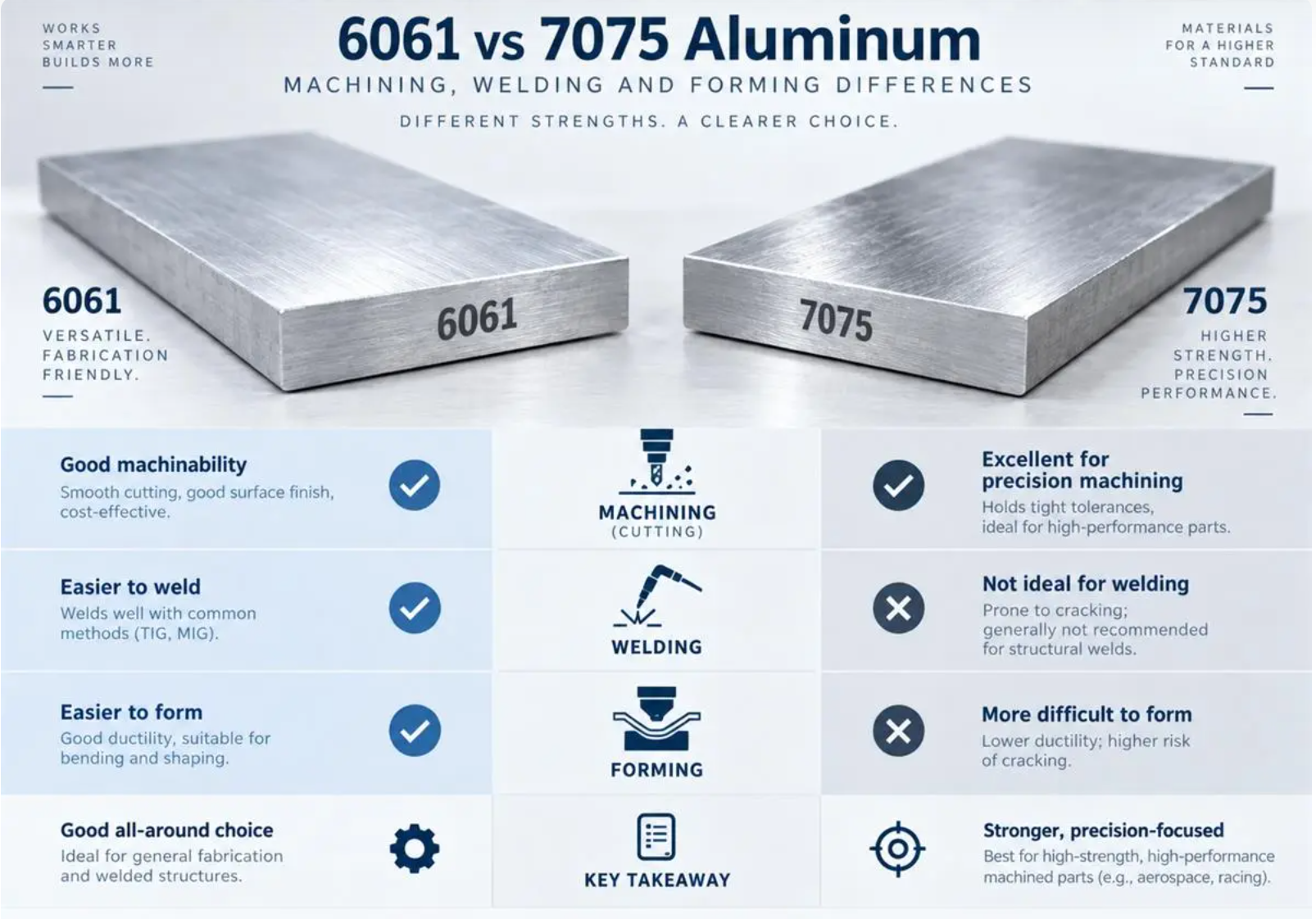
From a physical performance perspective, 7075 is known as "aerospace-grade aluminum." Its tensile strength can exceed 500 MPa, approaching that of some steels, while maintaining excellent lightweight advantages. This makes it the top choice for high-tech fields such as aerospace, racing components, and high-load robot joints.
In contrast, 6061 is a magnesium-silicon alloy with medium strength, but its greatest advantage lies in its superior CNC machinability. 6061 cuts smoothly, causes minimal tool wear, and has relatively low internal stress. In actual production, this translates to faster cutting speeds, longer tool life, and a lower risk of machining distortion.
"Many clients request 7075 during the prototyping phase simply because they 'feel it's safer,'" said a process director at a precision manufacturing company. "But if it's a standard equipment mounting plate or an electronic enclosure, using 7075 not only wastes the material's high strength but also accelerates tool wear due to its high hardness. The machining cost is typically 20% to 80% higher than using 6061."
The Hidden Threshold of Surface Treatment
Beyond machining costs, surface treatment is another critical factor in the decision. For many consumer electronics or commercial equipment that require a premium aesthetic, anodizing is an essential process.
6061 aluminum performs extremely well during anodizing, offering uniform coloring and vibrant hues, making it highly suitable for products with stringent appearance consistency requirements. On the other hand, because 7075 contains higher levels of zinc and copper, it is highly prone to color variations and dark spots during anodizing, which can even lead to uneven oxide film layers. If a company insists on using 7075 and expects a flawless surface finish, they usually have to pay extra for special pre-treatment processes, with no guarantee of a high yield rate.
How to Make a Scientific Material Selection Decision?
Industry experts recommend following this decision-making logic during the DFM (Design for Manufacturing) phase:
1. Standard structural parts and cosmetic parts: Choose 6061 first. For mounting plates, brackets, jigs, and equipment enclosures, if the load-bearing requirements are not stringent and a beautiful anodized finish is needed, 6061 is the optimal solution that balances performance and cost.
2. High-strength load-bearing and extreme lightweighting: Only then consider 7075. Only when a part is in a high-stress environment and the structural space is limited—meaning you cannot compensate by increasing wall thickness—is it worth paying for the high strength and weight-saving advantages of 7075.
3. Design for 6061 first, then evaluate the stress limits. A more economical design approach is to base the structural design on 6061, satisfying stress analysis by adding reinforcing ribs or reasonably adjusting wall thickness. Only upgrade the material when it is verified that 6061 truly cannot meet the requirements.
Conclusion
As profit margins in the manufacturing industry continue to shrink, controlling costs through scientific material selection has become one of the core competencies of a business. Moving away from the mindset that "the more expensive the material, the better," and deeply understanding the machining characteristic differences between 6061 and 7075, is key to selecting the right material at the design stage and truly achieving cost reduction and efficiency gains in CNC machining.
Guess you want to Know:
Haina's Service

0086 0755 23170739
0086-0755-24325235
ciky@hainamould.com
Room 1605, 16th Floor, Hongyu Building, No. 495, Donghuan 2nd Road, Longhua Subdistrict, Longhua District, Shenzhen, Gongdong ,China 518109


Copyright 2026 Hainamould.com All rights reserved.
-
 0086 0755 23170739
-
 Facebook
-
 WhatsApp
-
 LinkedIn
-
 TOP