CNC Machining
In the field of molds and precision manufacturing, CNC machining centers are one of the core production equipment. Depending on the number of moving axes, common machining centers can be classified into three types: three-axis, four-axis, and five-axis. Each type has its own characteristics in terms of movement mode, applicable scenarios, and equipment cost, and is suitable for processing parts of different complexity levels.
I. Differences in the number of motion axes
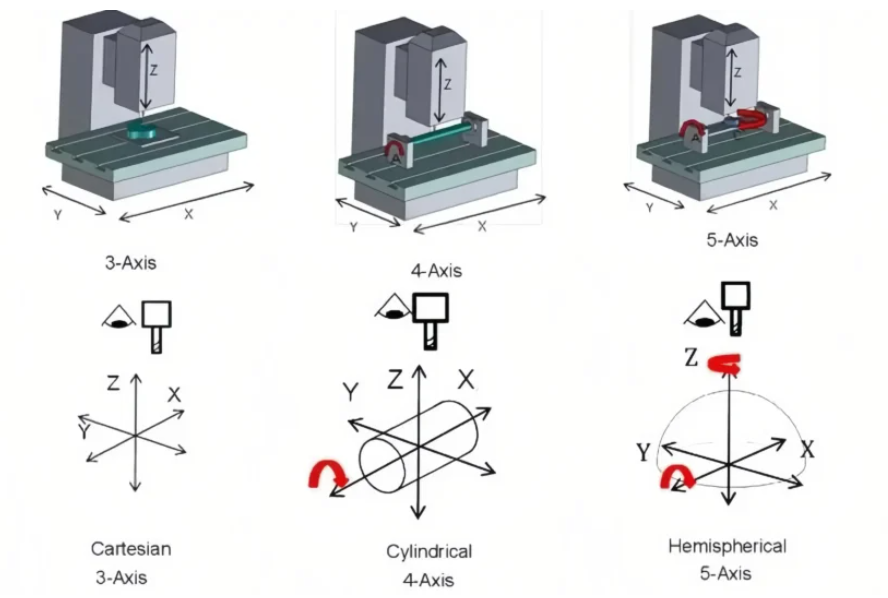
A three-axis machining center has three linear motion axes, namely the X-axis (left and right), the Y-axis (front and back), and the Z-axis (up and down). The tool moves along these three directions, and the workpiece is fixed on the worktable.
A four-axis machining center adds an additional rotating axis on the basis of the three axes, usually referred to as the A-axis (rotating around the X-axis) or the B-axis (rotating around the Y-axis). The workpiece can rotate around a certain axis during the processing.
A five-axis machining center adds another rotating axis on the basis of the three and four axes, forming a combination of two rotating axes and three linear axes, such as the simultaneous presence of the A-axis and B-axis, or the combination of A-axis and C-axis. This enables the workpiece or the tool to be processed at more angles.
II. Differences in the method of workpiece clamping
When processing multiple surfaces of a part using a three-axis machining center, the workpiece needs to be manually re-clamped for each surface, and the clamping position needs to be adjusted each time.
A four-axis machining center, due to its additional rotating axis, can automatically process multiple surfaces after one clamping, but this is limited to the surfaces that can be reached by the rotating axis.
A five-axis machining center can process almost all surfaces of the part after one clamping, including the sides, the bottom, and complex surfaces with inclined angles.
III. Whether the inverted structure can be processed
Inverted structures refer to the concave or reverse structural areas on the part. Three-axis machining centers cannot process the inverted areas. Four-axis machining centers, in general, also cannot process the inverted areas, but with special fixtures or specific angle assistance, they can achieve it under limited circumstances. Five-axis machining centers can use the tilting of the two rotating axes to enable the tool to reach the inverted area for processing.
IV. Methods of Deep Groove Processing
When processing deep groove structures, both three-axis and four-axis machining centers require the use of long-edge cutting tools. The tool overhang length needs to reach or exceed the depth of the cavity, and the tool length is proportional to the cavity depth. Five-axis machining centers can tilt the workpiece or the tool to enable short cutting tools to process the side walls and bottoms of deep grooves vertically or nearly vertically, without overly relying on long tools.
V. Typical Applicable Parts
Three-axis machining centers are suitable for flat parts, simple cavity molds, electrodes, heat sinks, and conventional drilling and tapping processing.
Four-axis machining centers are suitable for cylindrical cams, spiral grooves, worm gears, propellers, and parts that require multi-angle processing on cylinders or polyhedrons.
Five-axis machining centers are suitable for impellers, turbines, artificial joints, complex deep groove molds, molds with inverted structures for automotive interior parts, and precision parts in the aerospace industry.
VI. Core Advantages of Five-Axis Machining
Compared to traditional three-axis and four-axis equipment, five-axis machining centers have the following indispensable advantages in mold manufacturing:
1. Solving deep cavity processing problems and significantly improving surface quality
When processing deep cavity molds, three-axis equipment often requires the use of long cutting tools to reach the bottom of the cavity. The long tool extension is too large, which easily causes vibration marks, affecting the surface smoothness and dimensional accuracy. Five-axis equipment can tilt the workpiece or the tool to make short cutting tools process the side walls and bottoms of deep cavities vertically or nearly vertically, effectively avoiding vibration of the tool. The actual measurement data shows that after adopting the five-axis process, the surface roughness of the deep cavity area can be stably reduced to Ra 0.4 or below, meeting high-gloss, mirror-like, and other high-quality requirements.
2. Completing multi-face processing in one setup, eliminating cumulative errors
Traditional three-axis machining requires multiple manual workpiece setups. Each re-setup introduces positioning errors, which affect the overall accuracy, especially for parts with strict position requirements. Five-axis equipment can achieve one setup of the workpiece, automatically completing milling, drilling, tapping, and countersinking on multiple faces and angles. This not only improves production efficiency but also fundamentally eliminates the accuracy loss caused by multiple setups.
3. Enhancing overall efficiency and shortening delivery cycle
Five-axis machining reduces the auxiliary time for multiple setups, alignment, tool changing, etc., and can use more efficient cutting strategies. Preliminary statistics show that for medium-complexity precision molds, the five-axis process can shorten the processing cycle by approximately 30% compared to the traditional three-axis process, helping customers respond to market demands more quickly.
VII. Equipment Costs and Operating Requirements
Three-axis machining centers have relatively low prices and are relatively easy to program and operate. The training period for operators is short, making them a basic configuration for most mold manufacturing enterprises.
Four-axis machining centers have medium prices. Programming requires handling post-processing issues for rotating axes, and operation requires understanding the calibration methods for rotating axes.
Five-axis machining centers have higher prices. Programming is more challenging, requiring professional CAM software and rich post-processing experience. The operation and maintenance also need to be completed by personnel with professional capabilities.
Summary
Three-axis, four-axis and five-axis machining centers correspond to different processing requirements for parts with varying degrees of complexity and precision. The three-axis is suitable for regular planar and simple curved surface processing, the four-axis is suitable for cylindrical and polyhedral parts, and the five-axis is suitable for complex spatial curved surfaces, deep cavities and inverted structures. When enterprises select equipment, they should reasonably configure different types of machining centers based on their own product characteristics and order requirements.

0086 0755 23170739
0086-0755-24325235
ciky@hainamould.com
Room 1605, 16th Floor, Hongyu Building, No. 495, Donghuan 2nd Road, Longhua Subdistrict, Longhua District, Shenzhen, Gongdong ,China 518109


Copyright 2026 Hainamould.com All rights reserved.
-
 0086 0755 23170739
-
 Facebook
-
 WhatsApp
-
 LinkedIn
-
 TOP
TOP