
Injection molding
In injection molding production, a seemingly insignificant design decision - the placement of the gate - can often determine whether the final product is flawless or becomes a scrap. How to scientifically select the gate position and use modern technology to predict filling defects has become the focus of the industry.
Core principle: Five key considerations
The gate is the "throat" through which molten plastic enters the mold cavity. The selection of the gate position is not arbitrary. Industry experts point out that following the following five core principles is crucial:
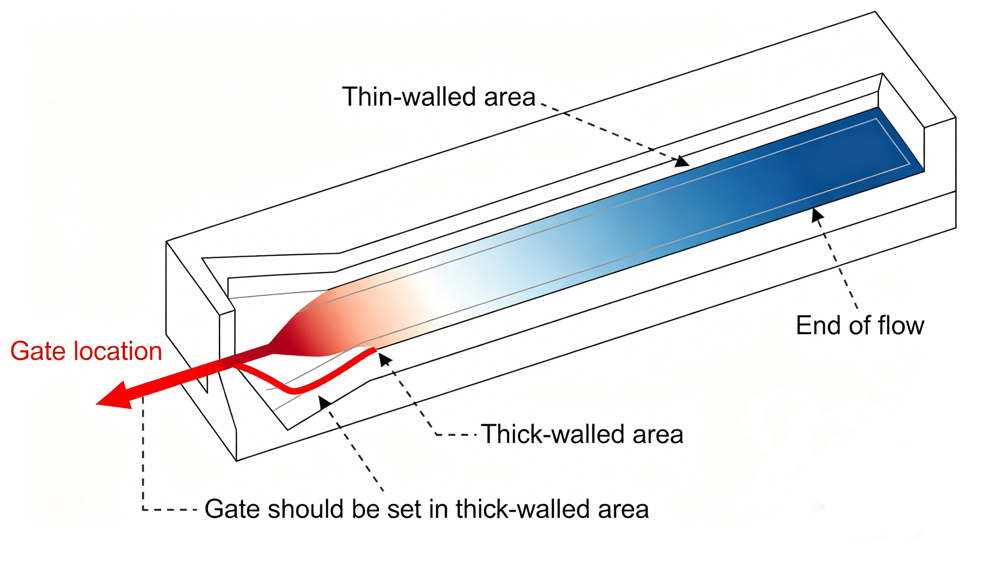
1. Enter from the thickest part
The gate should be prioritized to be set in the area with the thickest wall of the plastic part. The thick-wall area solidifies more slowly, which can ensure that there is sufficient time for the mold to fill each area during the holding pressure stage, effectively reducing shrinkage marks and internal air holes. On the contrary, if the gate is set in the thin-wall area, the melt flow towards the thick-wall area is prone to form a "lag phenomenon", resulting in short-shot defects.
2. Pursue balanced filling, avoid over-holding pressure
Ideally, the plastic melt should fill all the far ends of the mold cavity simultaneously. For multi-cavity molds or complex parts, the multi-gate design should ensure that each gate is responsible for approximately equal volume and flow, avoiding excessive local pressure that causes warping deformation.
3. Consider appearance and function
Gate marks are inevitable. They should be set in the concealed areas of the product (such as the inner surface, edge or bottom). At the same time, avoid setting the gate in high-load areas because the area near the gate usually has higher residual stress, and the weld marks will reduce the local strength.
4. Facilitates exhaust and prevents trapped air
The location of the gate should facilitate the smooth discharge of air from the cavity. If there is no exhaust groove at the final convergence area of the flow front, the high-pressure gas will be compressed and combusted, resulting in the burning or insufficient filling of the product.
5. Shortens the process and reduces pressure
For large or thin-walled parts, a long process means the need for extremely high injection pressure. Shortening the process by increasing the number of gates or optimizing their positions is an effective means to ensure the filling of the cavity.
Technical Breakthrough: Mold Flow Analysis
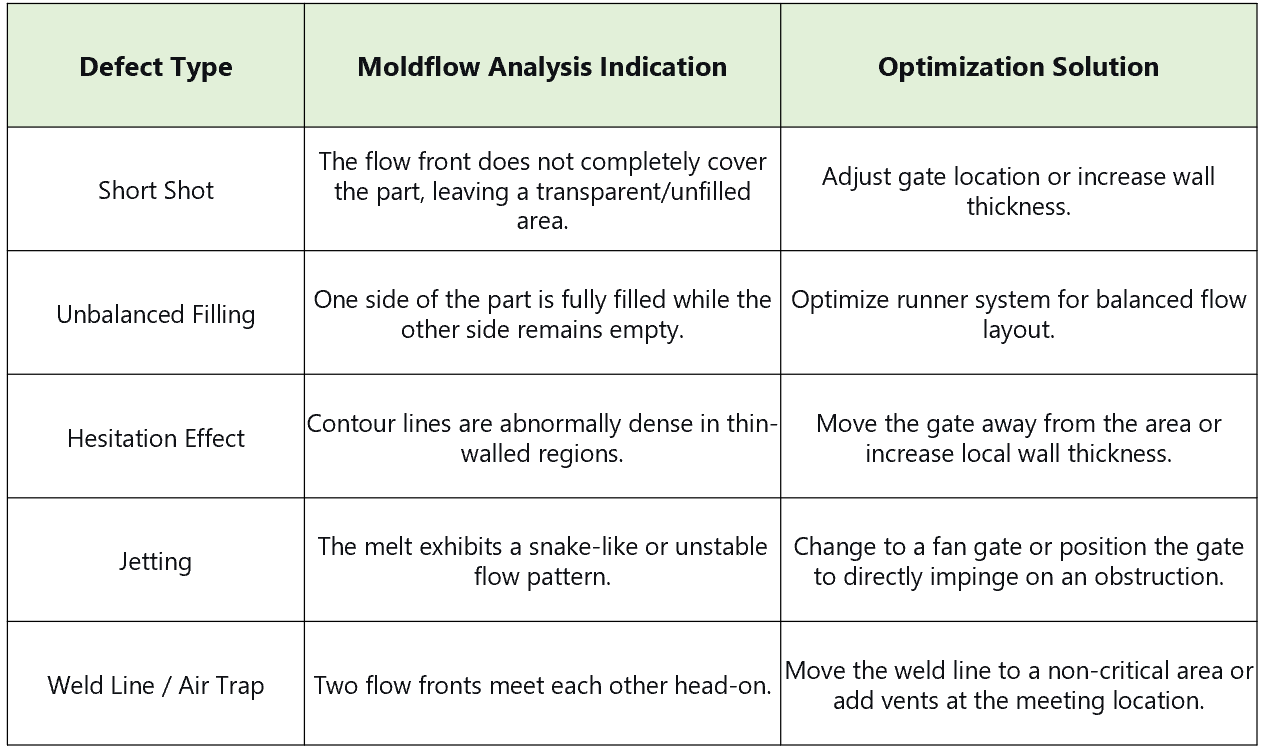
In the past, mold testing relied on experience, which was costly and time-consuming. Nowadays, the "filling time" analysis function of mold flow analysis software (such as Moldflow) has enabled engineers to peek into the "black box" of the mold.
By interpreting the filling animations and contour maps, various potential problems can be predicted before opening the mold.
Industry Outlook: From "Trial and Error" to "Scientific Design"
With the widespread adoption of mold flow analysis technology, the injection molding industry is transitioning from the traditional "trial and error" method to "scientific design". By conducting virtual mold testing before mold opening, various solutions can be quickly evaluated, allowing problems and costs to be resolved at the design stage. Experts suggest that engineers should master the principles of gate design and mold flow analysis tools proficiently. This is not only crucial for improving product quality but also a core competitiveness for reducing manufacturing costs and shortening development cycles.
In the future, with the deep integration of artificial intelligence and mold flow analysis, the intelligent optimization of injection molding processes will witness greater breakthroughs.

0086 0755 23170739
0086-0755-24325235
ciky@hainamould.com
Room 1605, 16th Floor, Hongyu Building, No. 495, Donghuan 2nd Road, Longhua Subdistrict, Longhua District, Shenzhen, Gongdong ,China 518109


Copyright 2026 Hainamould.com All rights reserved.
-
 0086 0755 23170739
-
 Facebook
-
 WhatsApp
-
 LinkedIn
-
 TOP
TOP