
Injection molding
In the process of product development and mold manufacturing, material selection is a crucial step that determines success or failure. If the right material is chosen, the cost can be controlled, the yield rate will be high, and the product performance will meet the standards; if the wrong material is chosen, no matter how precise the mold is, it will be of no avail.
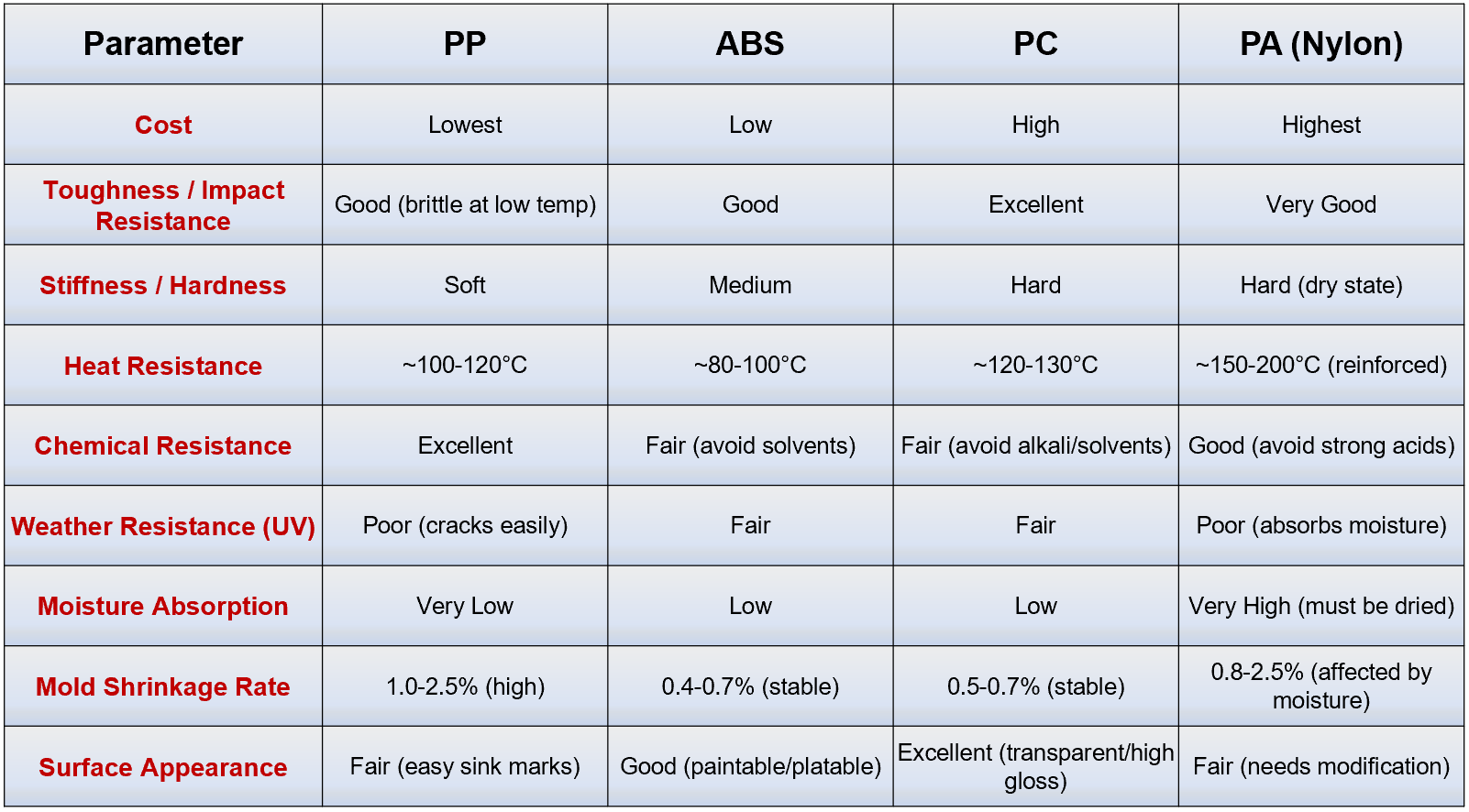
ABS, PC, PP, and PA (nylon) are the four most commonly used plastics in the injection molding industry, but their respective characteristics vary greatly. Today, we will use a table to clearly explain the selection logic of these four materials.
Recommendation based on product application scenarios
Let's start with PP. If your product is a daily item, such as a lunch box, storage box, stool, or a bottle cap for food packaging, or a syringe or petri dish for medical equipment, or even an automotive interior frame or an acid-base resistant container, PP is a very convenient choice. It is cheap, sufficient, and has a large capacity. But if your product requires painting or bonding, PP is not very suitable. It is not suitable for high-temperature environments above 120 degrees, nor for long-term outdoor exposure to sunlight. It is prone to aging and becoming brittle. Also, for those precision components with high dimensional accuracy, the shrinkage rate of PP is not stable, and you need to be extra careful when using it.
Now let's look at ABS. For home appliance shells such as televisions, air conditioners, vacuum cleaners, as well as electronic product shells including keyboards, mice, and those products that require electroplating or painting, these are all suitable for ABS. Its cost-performance ratio is very balanced, and its appearance is easy to handle. However, if you want to use the product for long-term outdoor use, ABS is not very resistant to sunlight, unless special UV stabilizers are added. It is prone to deformation when the temperature exceeds 90 degrees, and it cannot achieve the transparent effect, and its resistance to chemical corrosion is also average.
Now let's talk about PC. For parts that require a transparent effect, such as lamp covers, lenses, and windows, PC is a natural choice. It also has high requirements for impact resistance, like helmets, bulletproof glass, and goggles. PC is almost a standard option for these. If the product needs to work at high temperatures, such as in water heater components or microwave oven accessories, PC can handle it as well. Precision electronic parts like phone cases, connectors, and medical devices also frequently feature PC. Of course, it has its drawbacks - it has a higher cost, is not very resistant to chemical corrosion, and the surface is not easy to adhere to paint or electroplating. It will gradually turn yellow due to long-term outdoor exposure to sunlight. So if your product requires transparency, impact resistance, and a budget allows, then choose PC with confidence.
Finally, let's talk about PA, which is nylon. For parts that require lubrication and wear resistance, such as gears, bearings, and sliders, PA performs very well. It can also withstand high-temperature environments, such as components around engines or cooling fans. For structural components with requirements for strength and rigidity, tool handles, and scenarios that require glass fiber reinforcement such as PA6 + GF or PA66 + GF, as well as electrical internal components that require flame retardant levels, PA is the main player. But it also has some troublesome aspects - it is particularly sensitive to size accuracy requirements, as PA expands significantly after absorbing moisture. Cost-sensitive projects are not suitable for it either. It cannot achieve a transparent appearance, and for outdoor long-term use, it needs special UV resistance modification. In summary, if you need wear resistance, high-temperature resistance, and can accept glass fiber reinforcement, then choose PA. But remember two key points: during mold design, reserve sufficient shrinkage allowance, and must be thoroughly dried before molding.
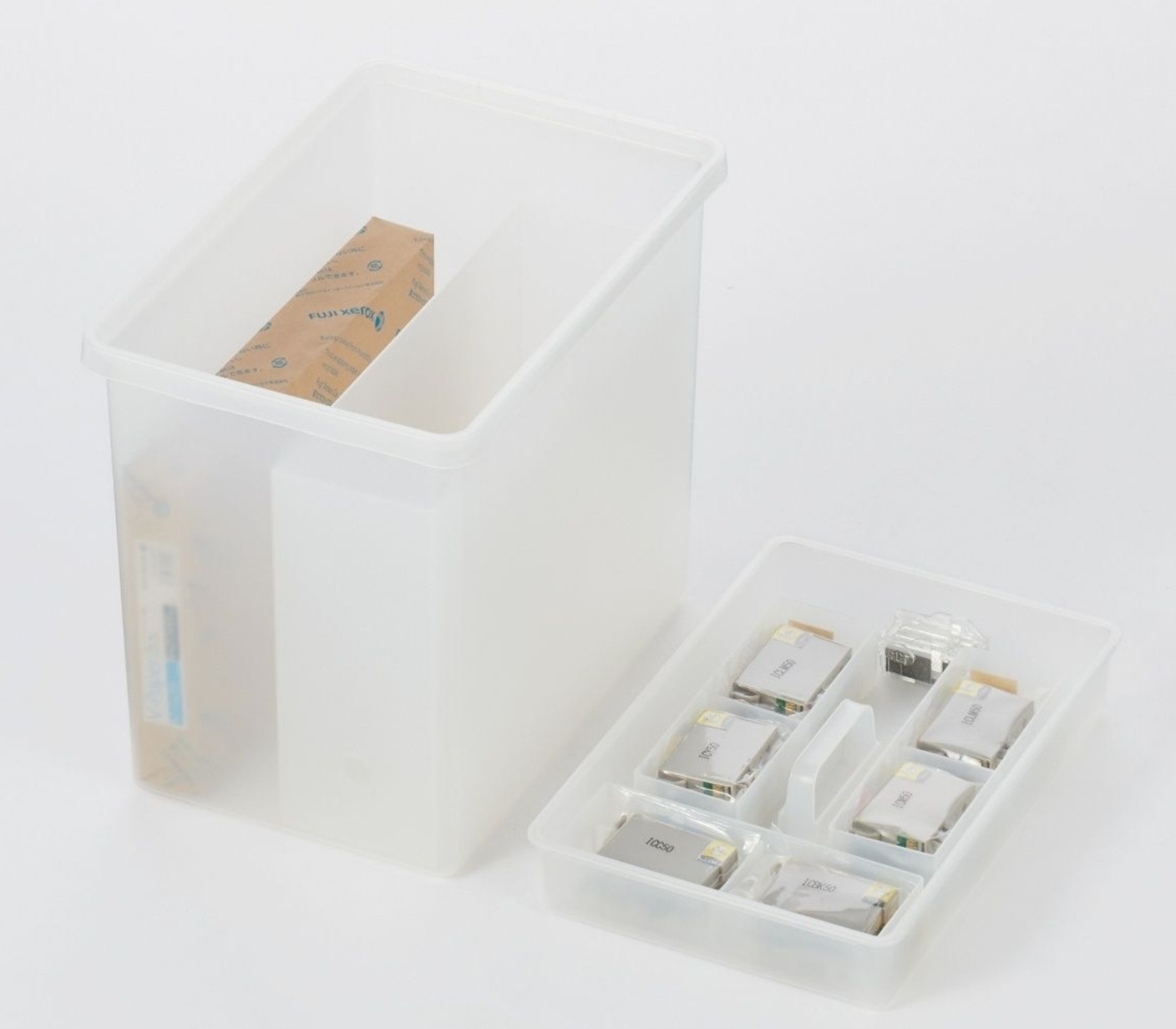
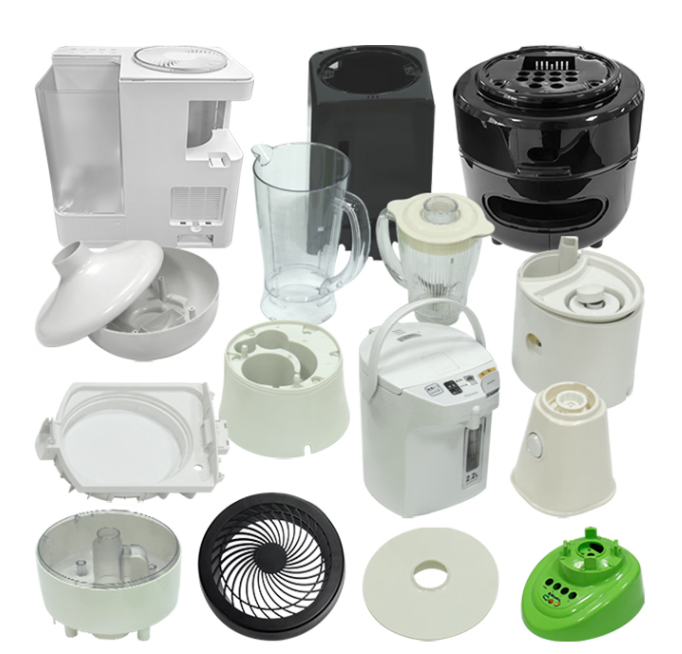
PP material storage box Various electrical appliance enclosures
If you want to develop a product, we will customize a dedicated material selection service process for you. When selecting materials, we need to take into account several aspects such as practicality, appearance, cost, and cost-effectiveness. Our professional advice to product developers is that the material selection not only affects the product performance but also directly influences the mold design and production cost:
1. Different shrink rates lead to different mold designs
PP has a shrinkage rate of 1.0-2.5%, so the mold cavity needs to be enlarged more
ABS/PC has a shrinkage rate of 0.4-0.7%, which is stable in size and suitable for precision molds
PA has a large variation in dry/wet state shrinkage rate, so adjustment space needs to be reserved during mold design
2. The requirements of materials for molds are different
Fiberglass-reinforced PA causes more wear on the mold, so wear-resistant steel and surface treatment need to be selected
Flame-retardant materials may produce corrosive gases, so the mold needs to be chrome-plated or made of stainless steel
Considerations for one mold with multiple cavities
Materials with good fluidity (PP, PA) can have more cavity numbers
Materials with poor fluidity (PC, high glass fiber content) need to reduce the number of cavities or increase the flow channel
4. Don't forget post-processing
If the product requires painting/electroplating, ABS is the best choice
PP/PE basically cannot be bonded or painted
Our website:https://www.hainamould.com/
Contact us: ciky@hainamould.com

0086 0755 23170739
0086-0755-24325235
ciky@hainamould.com
Room 1605, 16th Floor, Hongyu Building, No. 495, Donghuan 2nd Road, Longhua Subdistrict, Longhua District, Shenzhen, Gongdong ,China 518109


Copyright 2026 Hainamould.com All rights reserved.
-
 0086 0755 23170739
-
 Facebook
-
 WhatsApp
-
 LinkedIn
-
 TOP
TOP