
CNC Machining
In CNC machine tools, the C-axis generally refers to the rotary axis that rotates around the Z-axis (following the right-hand Cartesian coordinate system: X, Y, and Z are linear axes, while A, B, and C are their corresponding rotary axes). However, its specific meaning varies depending on the machine type.
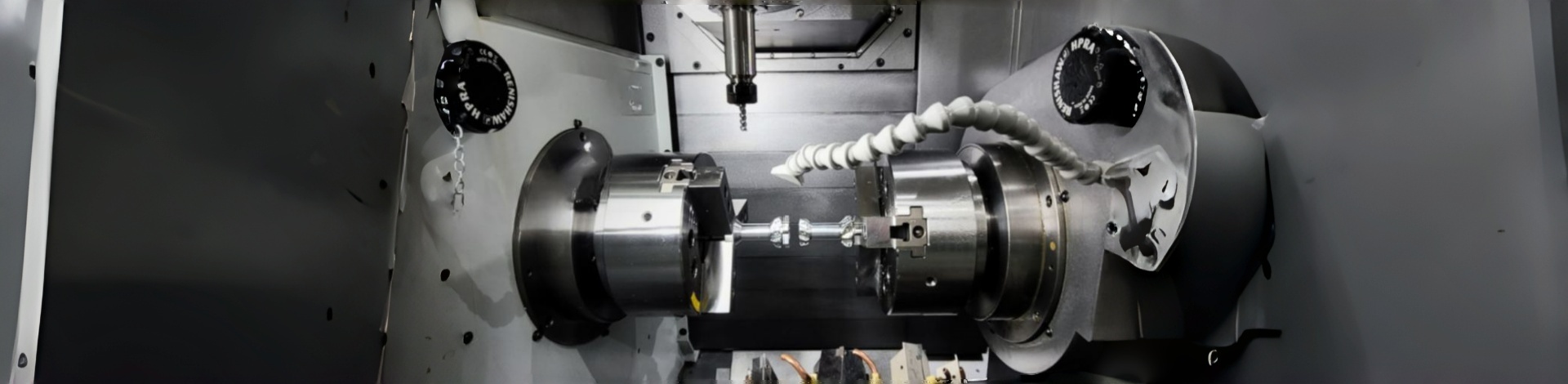
On mill-turn machines, the C-axis is essentially the workpiece spindle itself. During standard turning operations, the spindle rotates at high speed. When switched to C-axis mode, the spindle shifts to precise positioning or low-speed indexing rotation. With the C-axis, a lathe can perform keyway milling, radial drilling, and even polygon milling on cylindrical surfaces—enabling "turn-mill machining in a single setup."
On five-axis machining centers, the C-axis is typically the rotary axis of the worktable around the Z-axis. The worktable rotates the workpiece 360 degrees, and together with a tilting axis, it enables the machining of complex surfaces such as impellers and molds. In rare cases, the C-axis may also be located on the spindle head.
On standard three-axis machine tools, the C-axis does not usually exist unless an indexing head that rotates around the Z-axis is added as an attachment.
In simple terms, the C-axis adds an extra rotational degree of freedom to the machine—upgrading it from three axes to four or five—making it capable of machining more complex shapes, but also increasing the difficulty of programming and commissioning.

0086 0755 23170739
0086-0755-24325235
ciky@hainamould.com
Room 1605, 16th Floor, Hongyu Building, No. 495, Donghuan 2nd Road, Longhua Subdistrict, Longhua District, Shenzhen, Gongdong ,China 518109


Copyright 2026 Hainamould.com All rights reserved.
-
 0086 0755 23170739
-
 Facebook
-
 WhatsApp
-
 LinkedIn
-
 TOP
TOP