

Injection molding
In the injection molding industry, the most frequently discussed aspects are gate placement, cooling channels, and ejection balance. However, there is one step that is almost never specifically addressed during design reviews - it is this step that is called mold venting when problems arise during mold testing.
Why is it often overlooked?
The reason is simple: Venting seems "less important".
If the gate is not positioned correctly, the material cannot fill completely; if the cooling is not good, the product does not solidify for a long time; if the ejection is unbalanced, the product deforms directly. These problems are exposed in the first round of mold testing, and no one can avoid them.
Venting is different. It is not a "one-off rejection" flaw but a "chronic disease" - the mold can be used, and the product can be produced, but occasionally there are a few defective products, or there are always some unclear flaws on the surface. So people say: "Let's use it for now, and we'll adjust it next time."
And then there is no next time.
Another reason: The venting groove is indeed unobtrusive. It is just a shallow groove on the parting surface, with a depth measured in milimeters. On the drawing, it is just a thin line, and you won't even notice it if you don't look carefully in the actual product.
But if it damages the product, it would be extremely bad.
Charcoalization - the most obvious "exhaustion disease". When molten plastic is injected, compressed air is forced in. There is no place for the air to go, and it gets compressed to the very last point. The temperature can burn the plastic. A yellowish-brown mark appears at the end of the product, and in severe cases, it turns into carbonization.
Insufficient filling - the most hidden "exhaustion disease". Many people think it's due to insufficient pressure or speed, but in fact, the gas is blocked in corners and can't escape, resulting in an "air cushion effect". Blindly increasing pressure will only cause the mold to be stretched open and produce flash.
Worsening of the weld line - the most easily misdiagnosed. At the junction where the two material streams meet, there is already a weld line. If the gas can't escape, it will push the material streams apart, making the weld line wider and deeper, and the strength will decrease even more severely.
Surface defects - the nightmare of appearance components. Air entrapment forms air lines, flow marks, and irregular patches on the surface. You spent a lot of money on a mirror-like mold, but the product is all "ugly faces" - who can swallow this?
Why can't we rely solely on the parting surface?
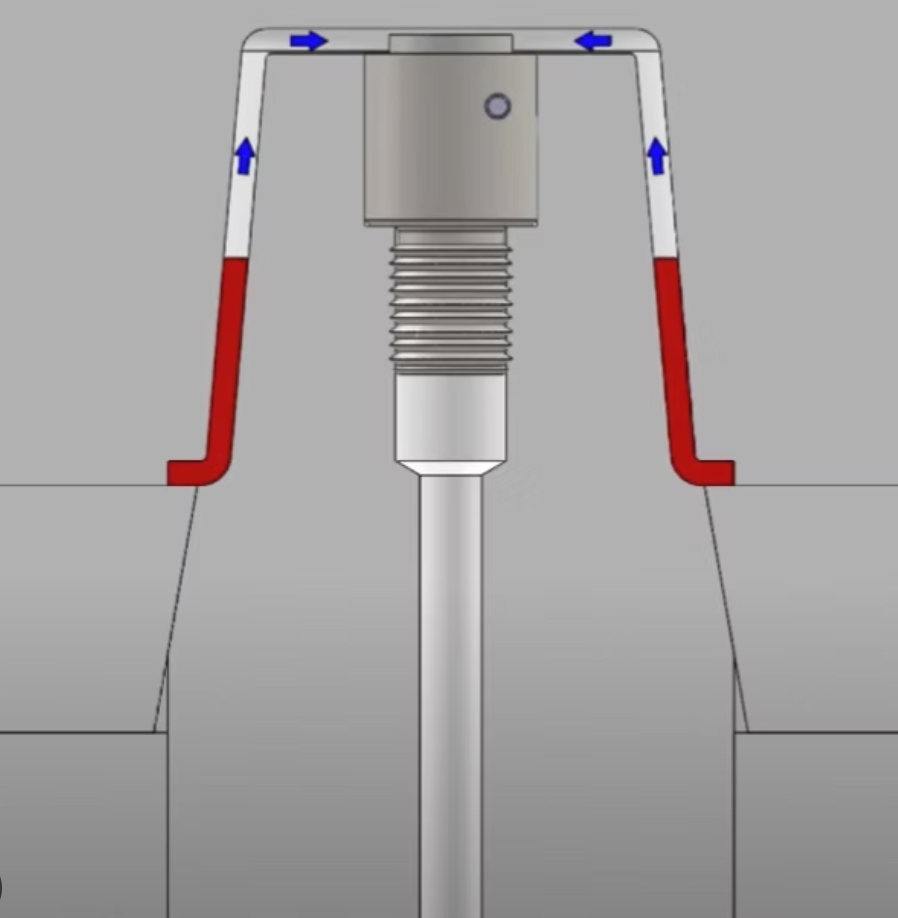
In actual production, injection pressure often reaches several hundred bars. After the mold closes, the parting surface is pressed tightly, and the gas simply can't escape. The professional approach is: specially grind exhaust grooves on the parting surface - the front end has a very shallow depth, so plastic can't go in but air can pass through; the rear end is deeper to allow the gas to flow out smoothly.
This depth is a matter of craftsmanship. If it's too deep, the plastic will drill in and form flash; if it's too shallow, the gas can't escape. Plastic with good liquidity (such as PA) may only have a depth of 0.01-0.02mm, while plastic with poor liquidity (such as PC) can have a depth of 0.05mm or so.
More concealed traps
The most easily overlooked exhaust problem often does not occur on the parting surface:
• Spur pins and sliders: The clearance between the moving parts and the mold is a natural exhaust channel. But if the fit is too tight, it will block the
exhaust path, which is a design contradiction.
• The ends of the main runner and branch runners also require venting; otherwise, trapped air will be pushed into the mold cavity.
• Interfacing seams: For multi-piece assembled structures, the seams are also potential exhaust channels, provided that the design takes this
into account.
Ultimately
The reason why mold exhaust is easily overlooked is that it is not like the gate that "decides success or failure", nor like cooling that "determines efficiency". It is an "invisible" presence - when it is well set, you don't notice it; when it is not well set, you are tortured by all kinds of inexplicable problems to the point of death.
A good mold design will not wait until the mold trial reveals burning until it opens the exhaust. It will systematically plan during the design stage: where to make slots on the parting surface, how deep; how to control the gap of the spur pin; whether there are corresponding measures for the trapped gas points in the mold flow analysis.
These "invisible" details determine whether a set of molds is "usable" or "good to use", and determine whether a workshop is constantly fighting fires or operating smoothly.
Exhaust is not an embellishment, but an indispensable foundation. Just like the foundation of a house - you can't see it, but without it, everything above is an empty tower.

0086 0755 23170739
0086-0755-24325235
ciky@hainamould.com
Room 1605, 16th Floor, Hongyu Building, No. 495, Donghuan 2nd Road, Longhua Subdistrict, Longhua District, Shenzhen, Gongdong ,China 518109


Copyright 2026 Hainamould.com All rights reserved.
-
 0086 0755 23170739
-
 Facebook
-
 WhatsApp
-
 LinkedIn
-
 TOP
TOP