
Industry Insights
In-depth Analysis: An AI Revolution That Is Shaping the Core of the Manufacturing Industry Executive Summary
To be honest, for the past few decades, injection molding simulation has always been the most troublesome computational bottleneck in product development. Engineers painstakingly design a solution, submit it, and then have to wait - for a few hours at the minimum, or even an entire night - to run the simulation once, and then gradually adjust and iterate. But now, this era is truly coming to an end.
By 2026, AI-driven simulations will no longer be just a novelty in laboratories, but will have truly entered factory workshops. From German companies launching large-scale injection molding models to Chinese manufacturers deploying "external AI brains" on production lines, the entire industry is undergoing a fundamental transformation: the simulation speed has been directly compressed from several hours to just a few seconds. The impact of this change cannot be overstated.
In this article, I will mainly discuss the current development status of AI simulation in the field of injection molding, with a particular focus on the situation in China.
I. Technological Transformation: What Happened?
Traditional Bottlenecks
Traditional injection molding simulation relies on numerical solvers - typically the finite element method (FEM) or the finite volume method (FVM) - these methods require solving complex physical equations such as melt flow, heat transfer, and pressure distribution. A high-fidelity simulation typically takes 2 to 8 hours, depending on the complexity of the part and the mesh density.
This has created a fundamental constraint: Engineers can only explore a few design iterations per week. In practice, many teams rely on an experience-driven "trial and error" approach rather than systematic simulation-driven optimization.
AI Breakthrough
In March 2026, German software company SIMCON released the world's first "Large Engineering Model" for injection molding: the Cadmould AI Solver.
The system is built on a Transformer-based neural network architecture—the same underlying technology as large language models like ChatGPT—
and has been trained on hundreds of terabytes of simulation data.
Core capabilities:
·Speed: Generates filling pattern, pressure, and temperature predictions in seconds—up to 1,000× faster than traditional solvers
·Generalization: Accurately predicts the behavior of entirely new part geometries without retraining
·Complementary design: Works alongside traditional solvers—AI for rapid exploration, numerical solvers for final validation
SIMCON CEO Bastiaan Oud explained: "The AI Solver provides engineers with a high-speed compass for iterative design, while our numerical solver
remains the authoritative map for final validation. Together, they form an end-to-end workflow that is both fast and reliable."
II. The AI Injection Molding Landscape in China: From Concept to Production Line
China is not only adopting these technologies but is also actively deploying them in factory workshops. The CHINAPLAS 2026 exhibition held in Shanghai in April 2026 showcased a mature ecosystem of AI-driven injection molding solution.
Tosida: AI-driven fully automated production line ( https://news.qq.com/rain/a/20260427A02NOW00?suid=&media_id= )
Tosida, one of the leading automation and injection molding solution providers in China, showcased a fully integrated AI injection molding unit at CHINAPLAS 2026.
This system produces cosmetic lip gloss bottles and realizes a fully automated workflow:
• High-speed electric injection molding machine
• Automated quality inspection
• Intelligent pallet stacking
• Humanoid robot material handling
• Zero human intervention
Check out this picture for the results:
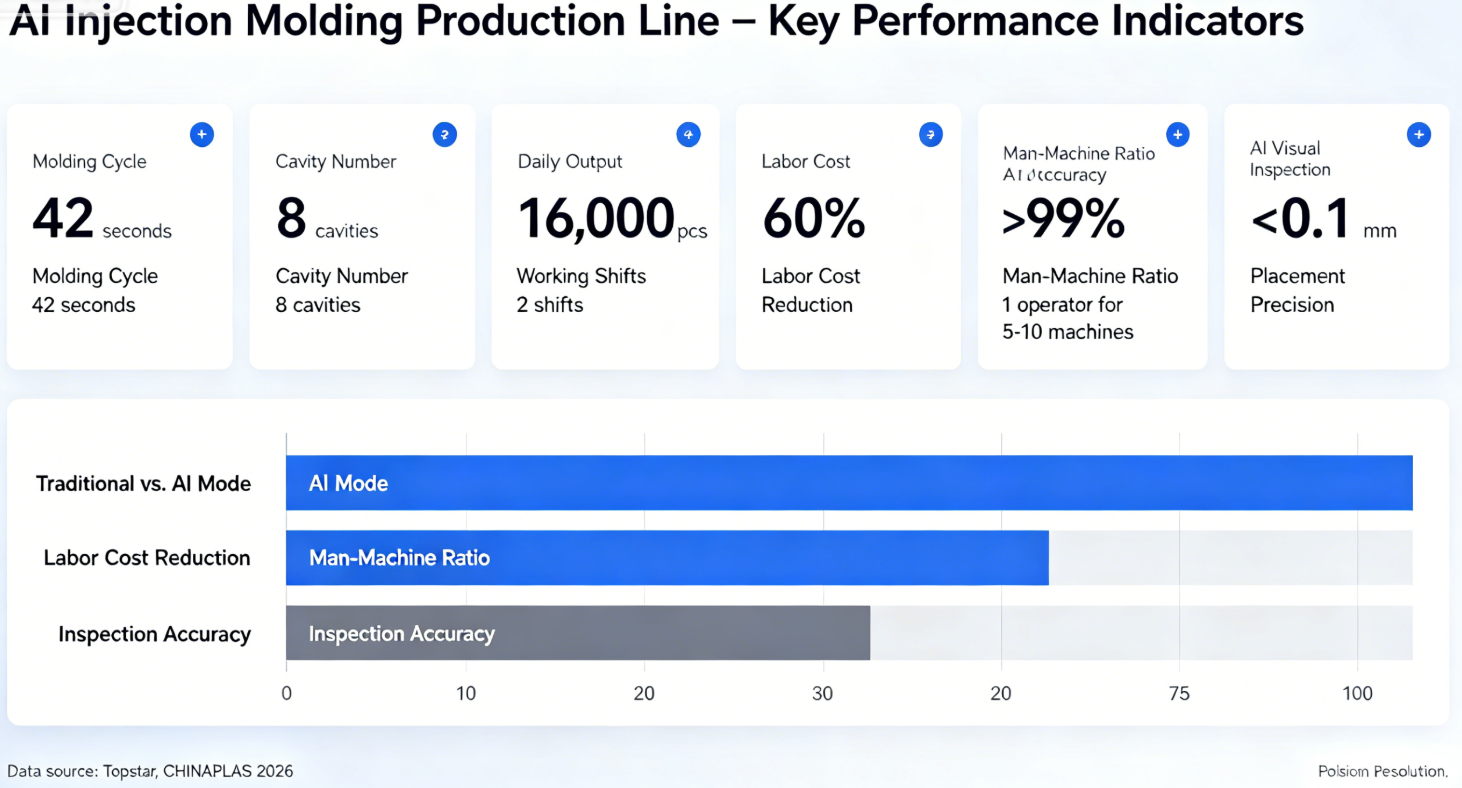
Tosida has also launched an AI intelligent sorting workstation to address the challenges of multi-variety and small-batch production. The changeover time is only 5 minutes (the industry average is 30-60 minutes), and the processing capacity per hour exceeds 1,000 pieces.
According to Tosida's report, during the exhibition alone, it reached cooperation intentions with international customers from countries such as India, Indonesia, and Egypt, covering fields such as automotive parts, 3C electronics, cosmetics, and food packaging.
III. Quantitative Evidence: What the Numbers Tell Us
The AI simulation technology has brought about significant improvements at three levels: in terms of speed, injection molding simulation has been shortened from traditional hours to seconds or near real-time; in terms of cost and efficiency, the success rate of the first mold no longer depends on personal experience, and the labor cost has been reduced by 60%; the number of personnel controlling equipment has increased from 1-2 to 5-10; in terms of design iteration cycle, it has been compressed from days to weeks to hours to days; in terms of cooling optimization, the AI-driven conformal cooling design, combined with proxy models and multi-objective evolutionary algorithms, has transformed the traditionally difficult-to-tune cooling process into a quantifiable argument, significantly reducing the cooling time, which accounts for 70-80% of the cycle.
IV. Insights for International Buyers and Future Outlook
For international buyers purchasing injection molded parts from China, the implementation of AI simulation technology has brought tangible value: suppliers can respond to design changes at an exponential speed, and the recommended first-mold parameters can be shortened from several hours to seconds, which means a shorter time to market; at the same time, the AI system converts the experience of experienced workers into transferable digital assets, reducing the reliance on individual technicians and achieving higher quality consistency - the accuracy of AI visual inspection has exceeded 99%, combined with real-time monitoring technologies such as "golden envelope lines", it can warn of defects before they occur. Although AI-assisted workflows have obvious advantages in early design exploration, the current technology still has limitations: studies have shown that the geometric shapes selected by AI may have deviations in stiffness and stress prediction, and the prediction accuracy of local stress sensitivity is not yet sufficient to completely replace traditional simulations. Therefore, AI is currently most suitable as an "accelerated compass" for engineers for rapid iteration, and final verification still requires traditional numerical solvers to oversee. Looking to the future, within 1-2 years, "AI co-pilot" will be widespread, and the cloud-edge hybrid architecture will become the mainstream; within 3-5 years, digital twin integration and autonomous process optimization will be achieved; within 5-10 years, generative mold design and self-optimal factories are expected to emerge. The message for the industry is clear: pay tribute to the past, but envision the future of simulation.

0086 0755 23170739
0086-0755-24325235
ciky@hainamould.com
Room 1605, 16th Floor, Hongyu Building, No. 495, Donghuan 2nd Road, Longhua Subdistrict, Longhua District, Shenzhen, Gongdong ,China 518109


Copyright 2026 Hainamould.com All rights reserved.
-
 0086 0755 23170739
-
 Facebook
-
 WhatsApp
-
 LinkedIn
-
 TOP
TOP