Injection molding
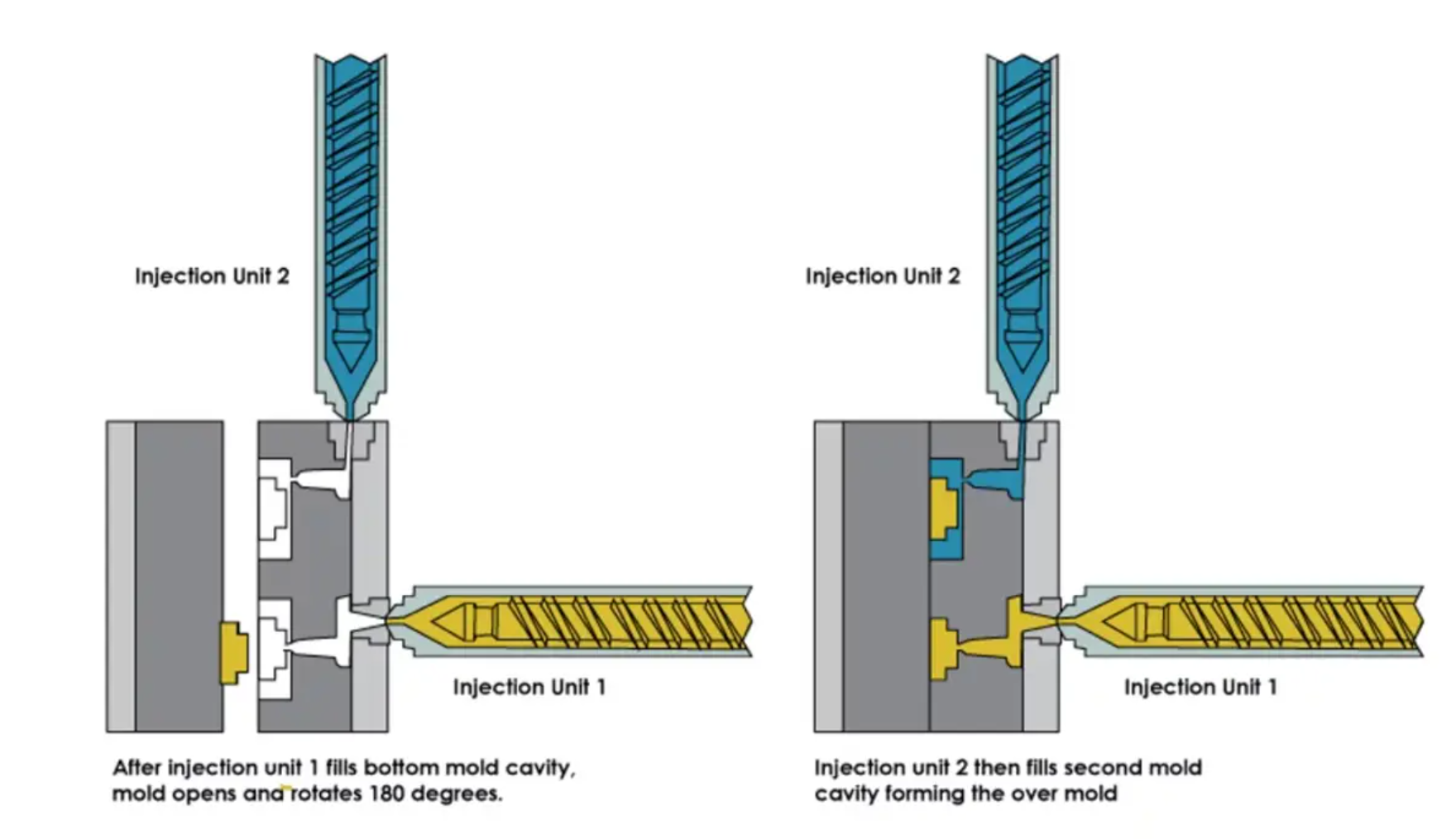
Overmolding,also known as secondary injection molding or two-color injection molding, is a molding technique that combines two different materials into one. Its basic principle is: first, a hard plastic part is injection molded as the framework, and then the component is placed in another mold, where a layer of soft rubber material (usually a thermoplastic elastomer, or TPE) is injected onto its specific surface. Under high temperature and pressure, the molecules of the two materials fuse at the contact surface, forming a strong and inseparable whole.
The core advantages of Overmolding
• Enhanced grip experience: The soft rubber layer provides a smooth and non-slip touch, effectively absorbing hand pressure, and is not prone to
fatigue even when used for a long time.
• Improved product durability: The soft rubber layer can buffer external impacts, protect the internal hard structure, and also serve as a sealing
and dust-proof function.
• Increased design possibilities: By combining different colors and textures, unique visual and tactile effects can be created, enhancing the quality
perception of the product.
Case of products produced by Haina Company:
This is a massage stick product produced by our company. If the entire stick is made of hard plastic, when users hold and use it, they will experience
a cold sensation. Long-term operation can cause hand numbness and soreness. Moreover, when sweating or applying massage oil, there is a risk of
slipping on the hard and smooth surface. Through the use of the overmolding process, this problem has been well resolved.
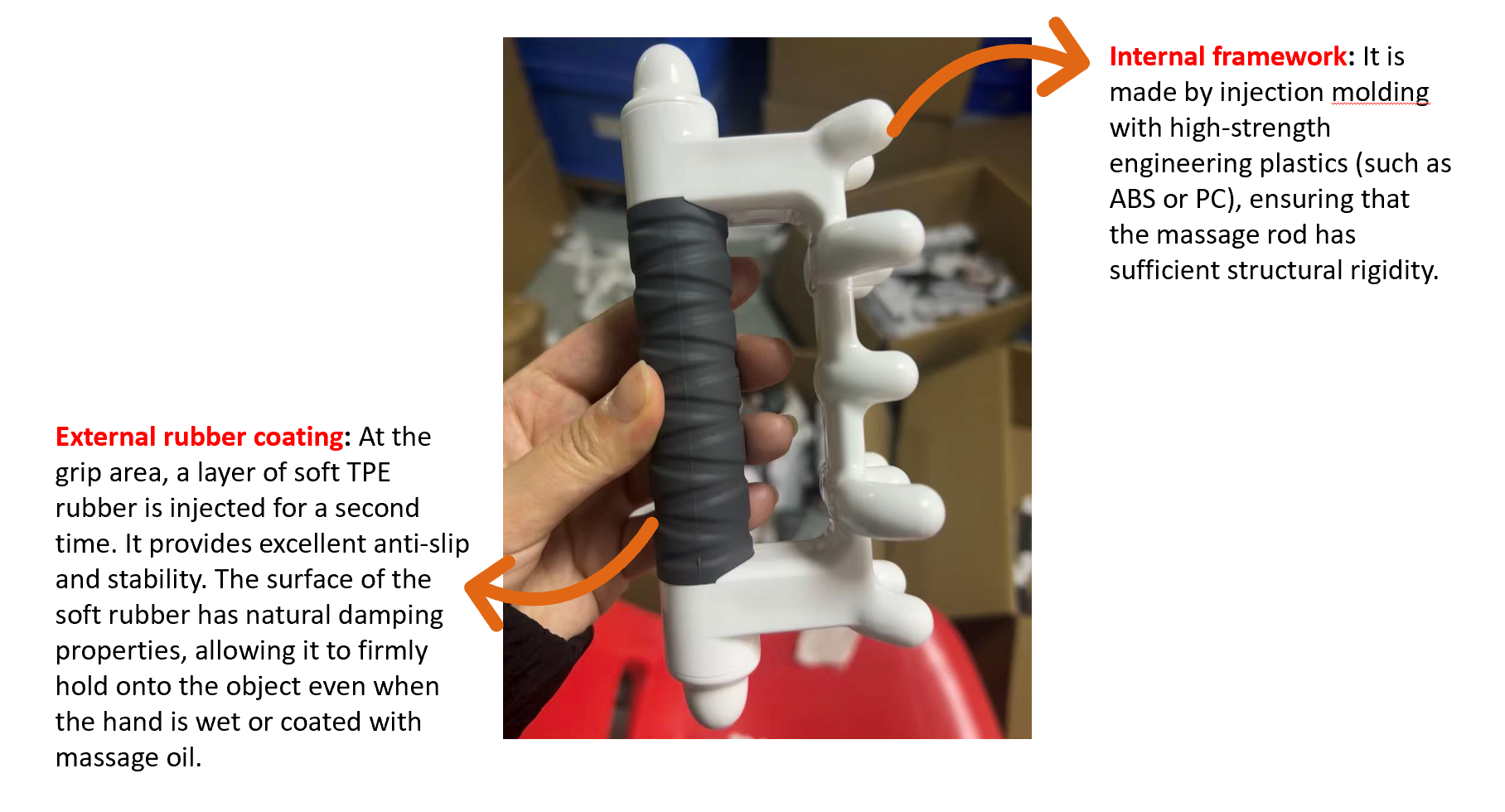
The final effect is as follows: The massage stick is sturdy and durable throughout, while the hand-holding area is soft, non-slip, and skin-friendly. The
transition between hardness and softness is smooth and natural, and the entire machine has a strong sense of unity, without any seams or traces of
glue application. This is precisely the quality upgrade brought about by the rubber-molding and injection process.
Technical Points and Precautions
To successfully achieve the process of rubber coating injection molding, several key technical points need to be considered:
• Material Compatibility: The hard core material and the soft rubber TPE must have good compatibility to achieve a strong chemical bond. For
example, the ABS/PC core is usually paired with TPE based on SEBS.
• Mold Design: The secondary injection mold needs to be precisely positioned to ensure that the soft rubber layer covers the designated area and
has uniform thickness.
• Process Parameters: The temperature of the core component, injection pressure, holding time, etc., all affect the bonding strength.

0086 0755 23170739
0086-0755-24325235
ciky@hainamould.com
Room 1605, 16th Floor, Hongyu Building, No. 495, Donghuan 2nd Road, Longhua Subdistrict, Longhua District, Shenzhen, Gongdong ,China 518109


Copyright 2026 Hainamould.com All rights reserved.
-
 0086 0755 23170739
-
 Facebook
-
 WhatsApp
-
 LinkedIn
-
 TOP
TOP