

Injection molding
In the design of injection molds, the arrangement of the ejector system directly affects whether the product can be smoothly and without damage removed from the mold. A reasonable ejector arrangement scheme requires finding the optimal balance point among the forces of ejection, product protection, motion stability, and processing economy.
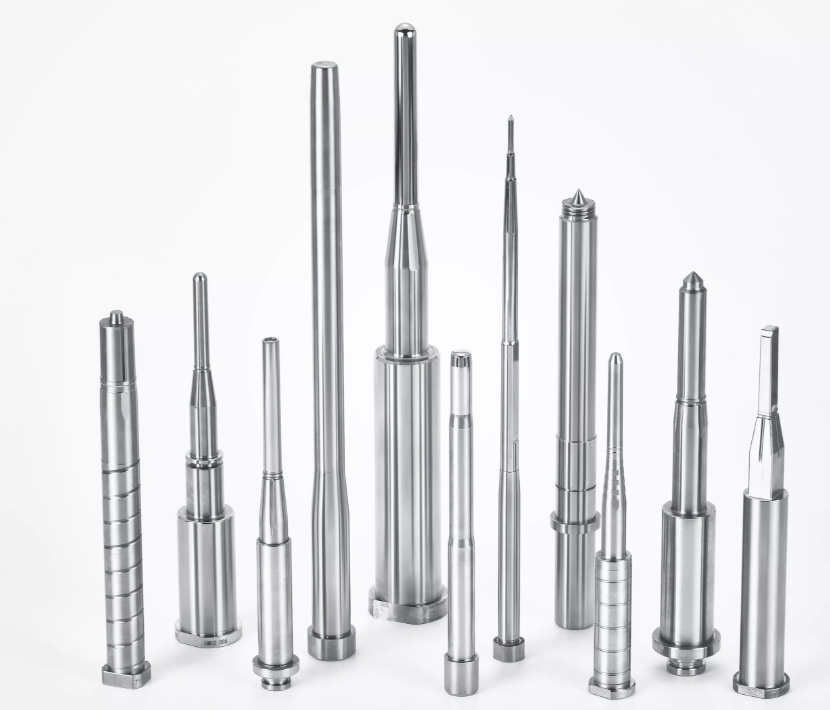
I. Principle of Ejector Force Balance
The balance of ejector force is the foundation of the entire arrangement scheme. The ejectors must be distributed symmetrically and at equal intervals based on the center of the mold or the product. This is because if the ejector force is not evenly distributed, the product will tilt during ejection, which can lead to ejection jamming or even breakage of the ejector, and also cause warping deformation of the product. In actual design, those areas with greater clamping force - such as deep cavity parts, the periphery of large cores, and areas with dense stiffeners - are often the places with the most concentrated ejection resistance. Therefore, the number of ejectors should be appropriately increased or larger-diameter ejectors should be selected to balance the resistance in these areas.
II. Principle of Effective Ejection
Ejectors must be placed at the exact positions where thrust is needed, rather than randomly and uniformly. The bottoms of stiffeners and columns also have significant ejection resistance, and ejectors must be set at their roots or nearby. It is particularly important to note that the center of the column position should not be used as the position for ejectors - that would cause the ejectors to pass through the column directly - instead, they should be placed at the bottom edge or around the column. In contrast, large and flat areas without structural features contribute less to ejection and are not suitable for placing ejectors alone at these positions.
III. Principle of No Damage to the Product
The arrangement of ejectors cannot be at the expense of product quality. From an appearance perspective, ejector marks should be placed inside the product, on the bottom surface, or on non-visual surfaces; if it is necessary to eject from visible surfaces, priority should be given to using ejector blocks or invisible ejectors consistent with the texture of the product. From a structural strength perspective, thin-walled areas, narrow stiffeners, and small columns are all fragile structures, and direct ejection in these areas is very likely to cause ejection through or cracking. The correct approach is to place the ejectors near these fragile structures in relatively thicker positions, or by adding ejector blocks to distribute the ejection force and avoid stress concentration.
IV. Principle of Stable and Reliable Motion
The motion reliability of the ejectors themselves is also not to be ignored. In terms of diameter selection, larger-diameter ejectors should be preferred because they have better bending stiffness, are less likely to deform, and have a longer service life. Fine ejectors need to be placed more densely and ensure that their guiding length is sufficient. The length of the ejectors also needs to be controlled, usually not exceeding 20 to 30 times its diameter, as it is prone to instability and bending during ejection. In addition, all ejectors must maintain a safe distance from waterways, cooling holes, screws, inserts, and sliders, and there should also be sufficient gaps between ejectors and the mold core boundary, usually no less than 1 to 2 millimeters.
In conclusion, the core of the mold pin arrangement can be summarized in eight words: balance, effectiveness, no damage, and reliability. In actual design, it is recommended to follow the basic principle of "first calculate the demolding force, then symmetrically place pins in the resistance concentration areas, take into account edge assistance, and avoid thin-walled and appearance surfaces". A memorable mnemonic is: "Deep cavities must have pins, symmetrically distributed force is uniform; large surfaces need auxiliary pins, thin-walled and fragile parts should be avoided." Only by integrating these several principles can a pin system be designed that not only meets the production stability but also ensures product quality.

0086 0755 23170739
0086-0755-24325235
ciky@hainamould.com
Room 1605, 16th Floor, Hongyu Building, No. 495, Donghuan 2nd Road, Longhua Subdistrict, Longhua District, Shenzhen, Gongdong ,China 518109


Copyright 2026 Hainamould.com All rights reserved.
-
 0086 0755 23170739
-
 Facebook
-
 WhatsApp
-
 LinkedIn
-
 TOP
TOP