
Automobile parts
The digital design and simulation of automotive molds essentially involve using a three-dimensional digital model in a computer to complete the entire process of mold conception, testing, and optimization.
The core logic of this process is: first, use CAD (Computer-Aided Design) to precisely "draw" it, then use CAE (Computer-Aided Engineering) to repeatedly "simulate" and verify, and finally use CAM (Computer-Aided Manufacturing) to efficiently "process" it. It has completely changed the traditional mold development model that relied on "master's experience" and repeated trial and error. Currently, the latest development in this field has entered a new stage of deep integration with artificial intelligence (AI) and digital twins.
1. Intelligent Design: From "Man Drawing" to "AI Generating"
The traditional three-dimensional design mainly relied on engineers to manually model, but with the intervention of AI, the efficiency of the design process has been greatly improved.
For example, enterprises like FAW-Volkswagen and Dongfeng Mold have already deployed AI mold design systems. Engineers only need to input the three-dimensional digital model of the product, and AI can automatically complete most of the mold structure design based on the built-in standardized knowledge base, liberating the designer from the heavy repetitive labor. When designing a new mold, they can directly call and modify it, shortening the design cycle.
2. Core Simulation: "Testing the Mold" in the Computer
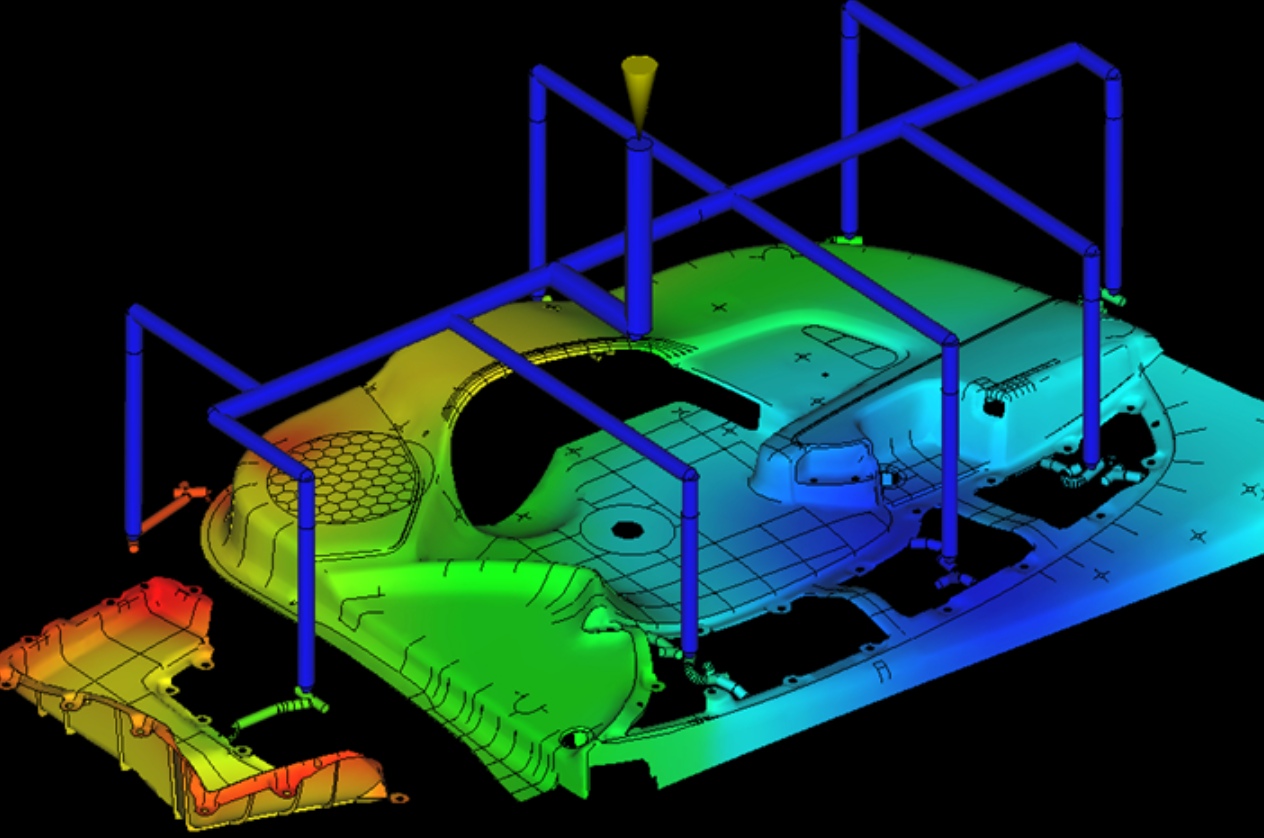
This is the most crucial part of digital simulation, mainly used to verify "whether the design is reasonable". It is like conducting a complete virtual mold test in the computer, discovering and solving problems in advance, and avoiding expensive physical rework.
• Pressing/Injection Molding Process Simulation (CAE):
o Pressing Field: Using software like AutoForm and DYNAFORM to simulate the process of metal sheet being stretched and formed in the mold, predicting where cracks and wrinkles will occur.
o Injection Field: Using software like Moldflow to simulate how molten plastic flows, fills, holds pressure, and cools in the mold cavity, analyzing the positions where bubbles, shrinkage, or warping deformation may occur.
• Motion and Interference Check:
o In software like UG/NX, perform motion simulation on the moving parts of the mold, such as sliders, side plates, and push rods, to check if they will "fight" with each other during the opening and closing of the mold, that is, to check for static or dynamic interference.
3. Leading Trends: AI Agents and Digital Twins
Digital simulation is evolving towards greater intelligence and greater precision, no longer simply "performing a calculation once", but forming a continuous optimizing closed loop.
As Jim Callari stated on https://www.ptonline.com/articles/how-one-custom-compounder-leverages-ai-to-drive-innovation-sustainability- artificial intelligence can only drive innovation and sustainability.

• AI Agents (Your "Digital Colleague") :
o Intelligent Knowledge Base: The "Little Mold" AI agent launched by Dongfeng Mold integrates a vast amount of technical standards and process methods internally. When engineers ask questions, it can answer them in seconds like an expert, equivalent to providing each designer with a portable technical encyclopedia.
o Automated Parameter Optimization: AI can automatically recommend the optimal combination of process parameters (such as mold temperature, injection pressure, etc.) based on CAE simulation results, helping engineers quickly find the best solution.
• Digital Twins (The Bridge Connecting Virtual and Reality) :
o Core Value: It is not just simulation, but rather establishing a digital entity that is exactly the same as the real mold. Through IoT data, the real equipment's data (such as wear conditions) is sent back in real time to the digital model, allowing the model to continuously "learn" and "evolve", becoming more accurate.
o Bidirectional Integration of Design and Manufacturing Data: Software like Moldex3D has already achieved direct data connection with injection molding machines, allowing the optimal molding conditions obtained from CAE analysis to be sent to the production equipment in one click, achieving "simulation as production", significantly reducing the debugging time from design to mass production.

0086 0755 23170739
0086-0755-24325235
ciky@hainamould.com
Room 1605, 16th Floor, Hongyu Building, No. 495, Donghuan 2nd Road, Longhua Subdistrict, Longhua District, Shenzhen, Gongdong ,China 518109


Copyright 2026 Hainamould.com All rights reserved.
-
 0086 0755 23170739
-
 Facebook
-
 WhatsApp
-
 LinkedIn
-
 TOP
TOP