
Company Blogs
Why is transparency important in modern manufacturing?
The value of transparent components lies in the fact that engineers can directly observe the internal structure without disassembling the product - whether the fluid flows smoothly, whether the components are accurately aligned, and whether the assembly is in place. This is especially valuable during the prototype verification stage and can significantly shorten the development cycle.
In addition, transparent components are pleasing to the eye and are widely used in consumer electronics, lighting equipment, medical systems, and automotive parts. Before production, using transparent models to evaluate the appearance and internal logic of the product has become a standard process for many R&D teams.
3D printers can produce transparent materials. Special formulations are available for transparent resins, transparent PETG, polycarbonate (PC), and transparent PLA. Industrial-grade printers (such as SLA, DLP, PolyJet) perform particularly well because their layer lines are finer and the surfaces are smoother.
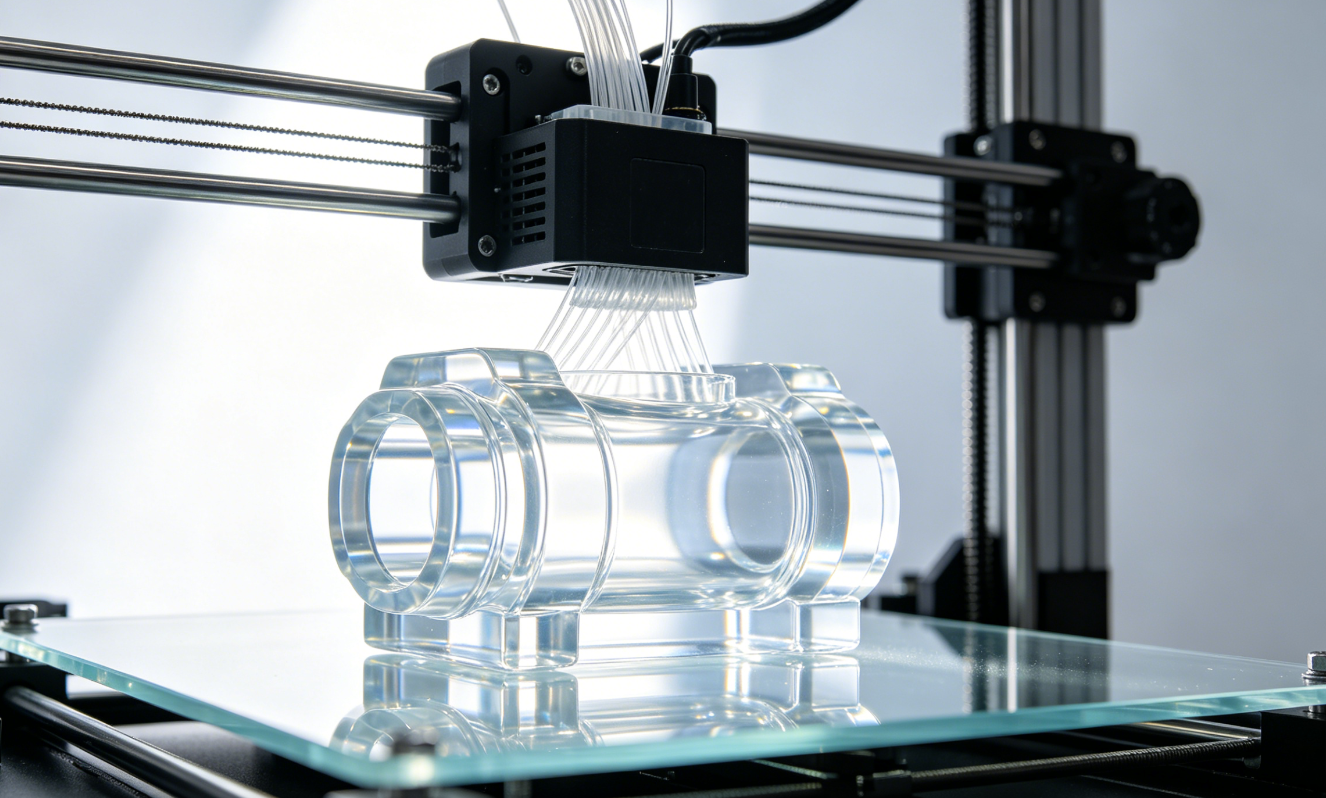
However, the key issue is that the transparent parts printed out usually are not as crystal clear as glass but rather have a "sanded glass" or "semi-transparent" appearance. This is because the layered stacking method causes light to scatter between the layers.
To achieve optical-grade transparency, post-processing is usually required: grinding, polishing, coating with resin or chemical smoothing. Different applications have different requirements for transparency - a lampshade can tolerate semi-transparency, but a fluid observation window must be close to optical clarity.
The differences among the three levels of transparency
• Semi-transparent: Light can pass through, but the internal details are scattered and blurred. Most FDM-printed "transparent parts" stop here.
• Transparent: Light passes through relatively well, and the background is visible but may have slight distortion. Suitable for protective covers, supports, etc.
• Optically clear: Close to glass or polished acrylic, with almost no distortion. Requires high-quality printing + a lot of post-processing, which is costly and difficult.
List of common transparent materials
• Transparent PLA: The easiest to print with FDM, but with obvious layer lines, requiring polishing and sanding.
• Transparent PETG: Better transparency and stronger layer adhesion than PLA, suitable for containers, lids.
• Polycarbonate (PC): Naturally transparent, high strength, heat-resistant, but difficult to print.
• SLA/DLP transparent resin: Currently the best overall choice, with a smooth surface, suitable for lenses, medical models.
• Acrylic-like photopolymer (PolyJet): Industrial grade, can achieve extremely high clarity, used for high-precision prototypes.
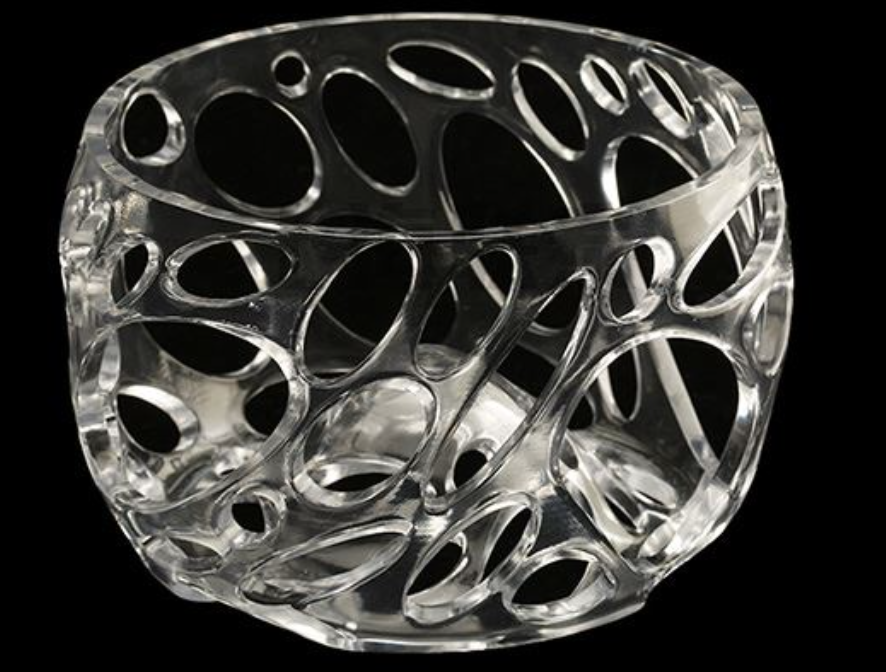
The key factors affecting the transparency of 3D printing and common issues
🟡Key factors:
1. Layer height: The lower, the better (≤ 0.05mm), to reduce layer line scattering.
2. Temperature and Speed: Improper settings can result in bubbles, burning, uneven extrusion, and reduced transparency.
3. Bubbles and internal defects: Moisture/gases present in the consumables or resin can scatter light, thereby compromising clarity.
4. Material quality: Materials with fewer impurities and thorough drying show significantly better performance.
🟡Problem:
The layer lines cannot be completely eliminated: Even with high-resolution printing, the fine ridges will still affect the light transmittance, and post-processing grinding is required.
Long-term yellowing: Some materials will turn yellow when exposed to high temperatures, ultraviolet rays, or when not fully cured.
Deformation or cracking: Materials like PC are prone to cracking if they are not cooled evenly, and a temperature-controlled environment is necessary.
The scratches are obvious: The more transparent the part is, the more noticeable the scratches will be. Extra caution is required when handling.
Examples of practical applications

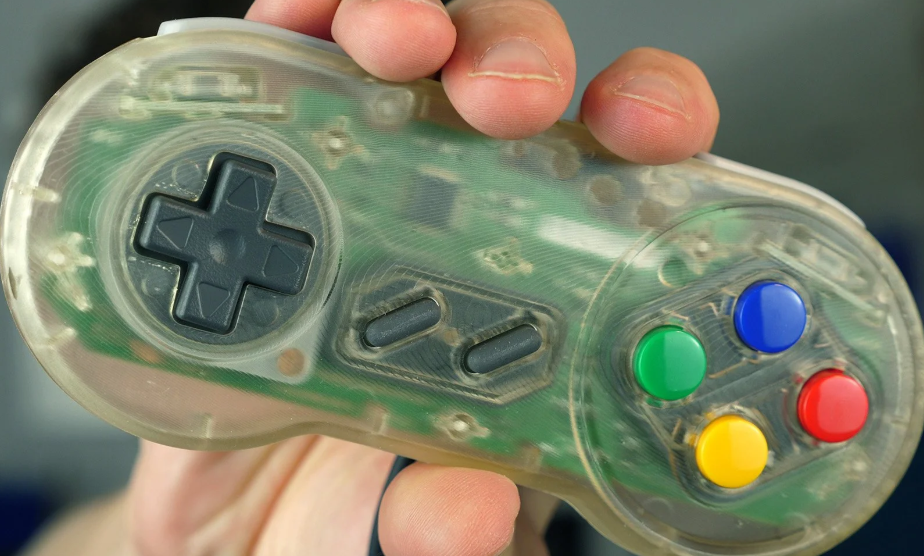
Transparent medical materials Transparent electronic products
Although 3D-printed transparent parts cannot yet directly replace the transparent products in injection molds (there are still differences in surface quality, heat resistance, and long-term stability), their value in prototype verification and small-batch production of transparent samples is already very clear.

0086 0755 23170739
0086-0755-24325235
ciky@hainamould.com
Room 1605, 16th Floor, Hongyu Building, No. 495, Donghuan 2nd Road, Longhua Subdistrict, Longhua District, Shenzhen, Gongdong ,China 518109


Copyright 2026 Hainamould.com All rights reserved.
-
 0086 0755 23170739
-
 Facebook
-
 WhatsApp
-
 LinkedIn
-
 TOP
TOP