
Company Blogs
I. Mould Base: The Support and Guiding System
The mould base is the fundamental framework of the mold. It does not participate directly in product forming but serves the functions of support, fixation, and guidance. It consists of multiple steel plates and standard components, mainly including:
·Clamping plates (top and bottom plates): Used to secure the mold to the injection molding machine.
·Support blocks (spacer blocks): Provide clearance for the ejection mechanism to operate.
·Ejector plate and ejector pins: Responsible for pushing the finished part out of the mold after it opens.
·Guide pins and guide bushings: Ensure precise alignment of the mold halves during opening and closing, preventing any deviation.
Mould bases are typically manufactured by specialized mould base suppliers according to standard specifications and offer high interchangeability. Currently, standard mould bases such as "LKM" (Longji) are widely used in China's mold industry, with models like CI type and FCI type, which can meet most injection molding requirements.
II. Core & Cavity: The Key Components That Determine Product Shape
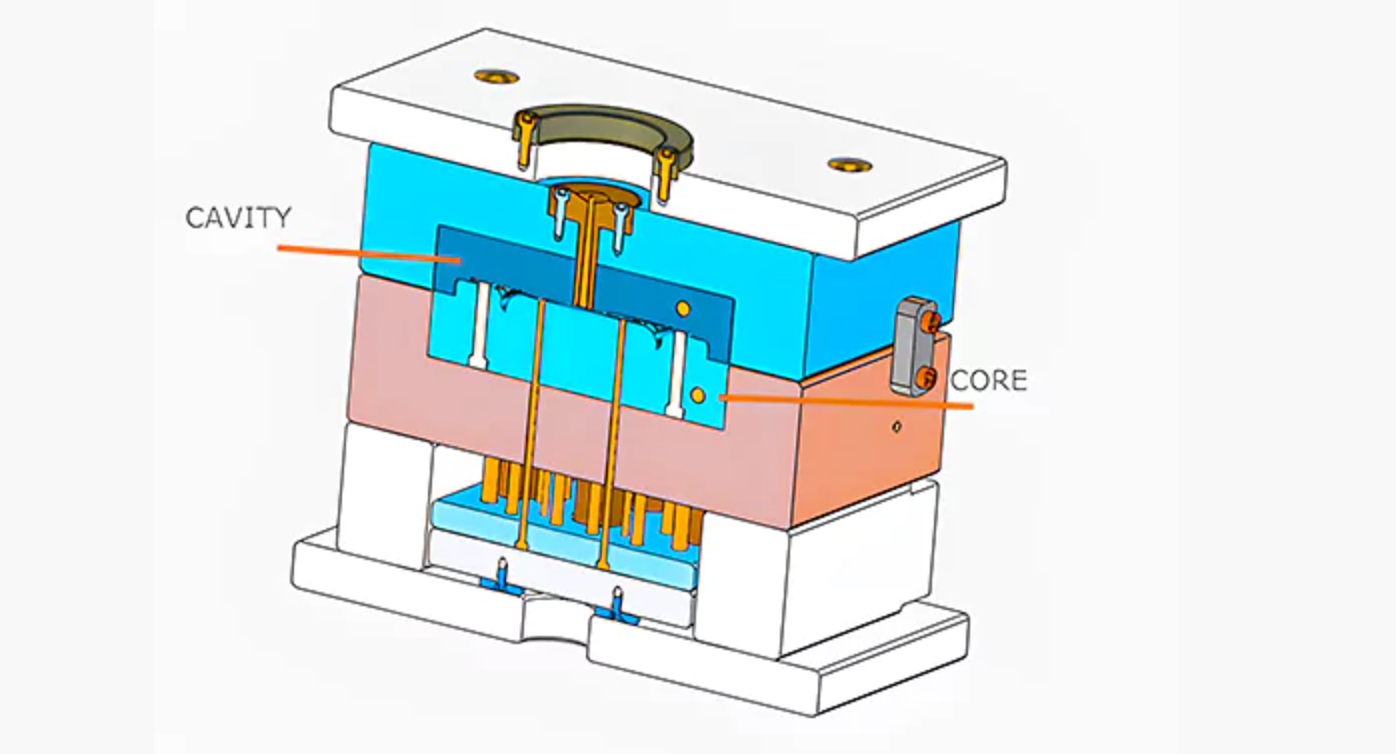
The core and cavity are the parts of the mold that actually come into contact with the plastic and determine the product's geometry. They are generally divided into the cavity (on the fixed half, or stationary side) and the core (on the moving half). The surfaces of these components directly correspond to the exterior and interior walls of the finished part.
The machining precision of the core and cavity directly determines product quality. Their manufacture involves processes such as CNC machining, Electrical Discharge Machining (EDM), and wire cutting, with tolerances typically controlled within the range of ±0.01mm to ±0.005mm. The materials used for the core and cavity are typically heat-resistant and wear-resistant tool steels, such as P20, 718H, and S136, to ensure they do not deform under prolonged exposure to high temperature and pressure.
III. Auxiliary Mechanisms: Enabling Complex Functions
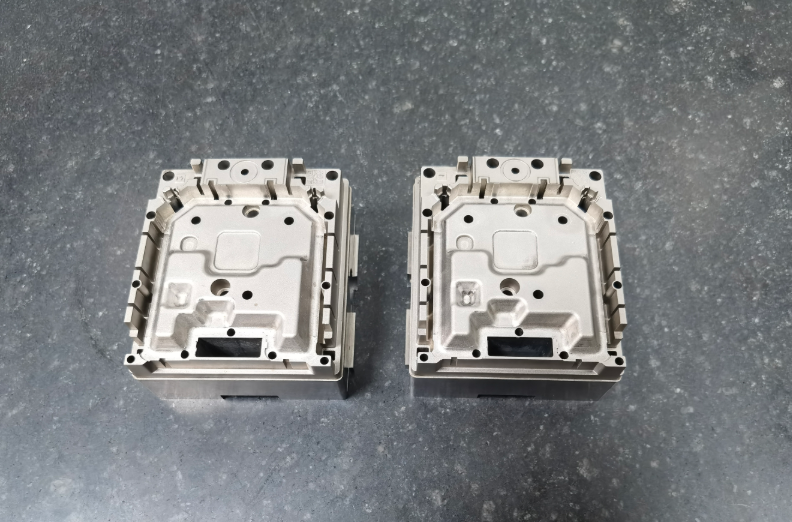
In addition to the mould base and the core & cavity, molds are equipped with a range of auxiliary mechanisms to meet complex molding requirements:
·Sliders and angled lifters: Used to form undercut features on the side of the product (e.g., snaps, threads). They retract laterally before the mold opens to allow the part to be ejected.
·Cooling system: Water channels are built into the mould base. Circulating water or oil is used to control the mold temperature, reducing the cycle time and ensuring dimensional stability of the parts.
·Sprue system: Includes the main runner, secondary runners, and gates, which guide the molten plastic from the injection molding machine's nozzle into the cavity.
IV. Classification of Molds
Depending on the molding process and materials used, molds can be categorized into several types, including plastic injection molds, stamping dies, die-casting dies, and rubber molds, among others.

0086 0755 23170739
0086-0755-24325235
ciky@hainamould.com
Room 1605, 16th Floor, Hongyu Building, No. 495, Donghuan 2nd Road, Longhua Subdistrict, Longhua District, Shenzhen, Gongdong ,China 518109


Copyright 2026 Hainamould.com All rights reserved.
-
 0086 0755 23170739
-
 Facebook
-
 WhatsApp
-
 LinkedIn
-
 TOP
TOP