
Company Blogs
In die casting production, the fundamental difference between cold chamber and hot chamber die casting lies in whether the melting furnace and the injection mechanism are integrated. This difference determines the applicable materials, product characteristics, and cost structures of each process.
Haina Precision Tooling Co., Ltd. analyzes this for you from three dimensions. If you'd like to learn directly, click the link below:
Click here to start
Core Differences:
1. Different operating methods (the most critical)
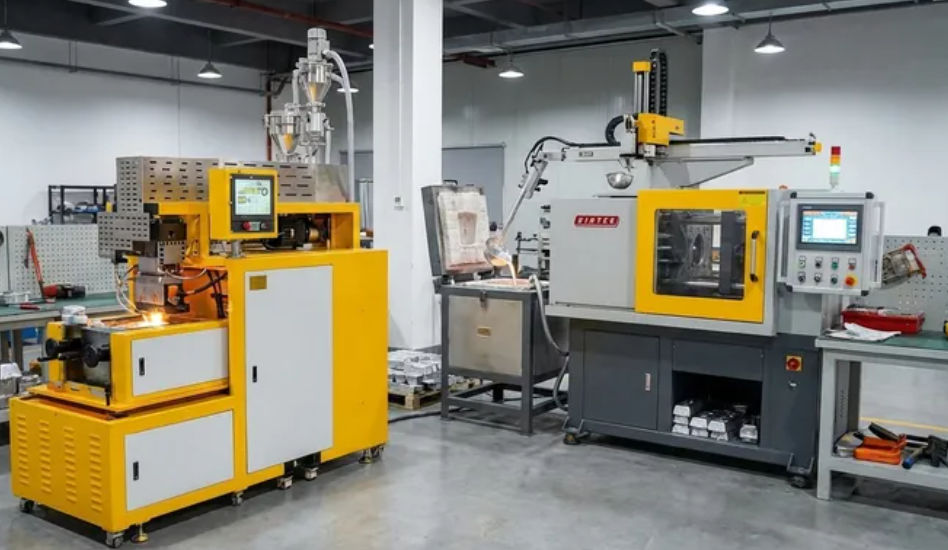
Hot chamber die casting: The melting furnace and injection chamber are integrated. The molten metal is kept at a constant temperature in the gooseneck tube. During injection, the plunger directly pushes the liquid metal into the mold cavity. The action is smooth, and the cycle time is extremely short (typically 3–5 seconds).
Cold chamber die casting: The melting furnace is independent and external to the machine. Before each injection, a robotic arm or manual labor scoops a measured amount of molten metal into the cold injection chamber, and then the plunger is pushed to complete the filling. Due to the "scooping" action, the cycle time is longer (approximately 7–15 seconds).
2. Completely different applicable materials
Hot chamber die casting: Only suitable for low-melting-point alloys, such as zinc alloys, tin alloys, and lead alloys. Since the injection components are immersed in high-temperature molten metal for long periods, if used for aluminum alloys (melting point above 660°C), the gooseneck tube and plunger would corrode rapidly, drastically shortening equipment life.
Cold chamber die casting: Specifically designed for high-melting-point alloys, such as aluminum alloys, magnesium alloys, and copper alloys. The injection chamber is separated from the melting furnace, avoiding prolonged thermal erosion of the injection mechanism by high-temperature molten metal.
3. Differences in casting quality and post-processing
Hot chamber: Smooth filling, less prone to air entrapment, high surface finish, suitable for thin-walled and complex small parts; however, the runner system (biscuit) wastes material, and the holding furnace tends to generate oxide dross, affecting melt cleanliness.
Cold chamber: Higher injection pressure (up to 100 MPa or more), suitable for thick-walled, heavy-duty structural parts with high strength requirements; however, the scooping and pouring process can introduce gas, resulting in higher internal porosity, often requiring impregnation or heat treatment for strengthening.
How to choose?
In actual production, the choice is not about "which is better," but "which is more suitable." We recommend making the decision in the following order of priority:
Step 1: Look at the material (hard constraint)
Zinc alloys, tin alloys → Prioritize hot chamber
Aluminum alloys, magnesium alloys (except thin-walled parts), copper alloys → Must use cold chamber
(Note: In recent years, some thin-walled magnesium parts can also use hot chamber, but cold chamber remains the mainstream.)
Step 2: Look at output and efficiency
High-volume small parts with annual production over one million units (e.g., zipper heads, lock cylinders) → Hot chamber, with its ultra-fast cycle speed, can achieve 1.5 times the daily output per machine compared to cold chamber.
Small-to-medium batches with frequent product changeovers → Cold chamber is more flexible (easier to change materials and clean).
Step 3: Look at wall thickness and air-tightness requirements
Uniform wall thickness and high air-tightness requirements (e.g., hydraulic valve bodies) → Cold chamber's high-pressure filling better ensures density.
Extremely thin walls (below 0.5mm) with mirror-like electroplating surface requirements → Hot chamber's smooth filling avoids cold shuts and flow marks.
Step 4: Calculate total cost
Hot chamber machines have lower purchase costs (about 60% of a cold chamber machine of the same tonnage) and require no separate furnace footprint, making them suitable for small workshops; however, biscuit re-melting loss is about 3%–5%.
Cold chamber machines are more expensive, but melting loss can be controlled within 1%, and large tonnage (800T and above) is only achievable with cold chamber—this is something hot chamber cannot replace.
Start Your Project Now
📧 Email: ciky@hainamould.com
🌐 Website: https://www.hainamould.com/Contactus/SendMessage
👉 Submit Your Drawings for a Free Technical Evaluation and Quote
(Please upload your 3D/2D drawings, material specifications, estimated quantity, and delivery requirements. We will respond within 24 hours.)

0086 0755 23170739
0086-0755-24325235
ciky@hainamould.com
Room 1605, 16th Floor, Hongyu Building, No. 495, Donghuan 2nd Road, Longhua Subdistrict, Longhua District, Shenzhen, Gongdong ,China 518109


Copyright 2026 Hainamould.com All rights reserved.
-
 0086 0755 23170739
-
 Facebook
-
 WhatsApp
-
 LinkedIn
-
 TOP
TOP