Company Blogs
1. What Is the "Steel" Used in 3D Printing?
3D printing does not use traditional solid steel billets. Instead, it uses specially formulated metal powder, which is melted and stacked layer by layer using a laser or electron beam. In mainstream metal 3D printing processes (such as laser powder bed fusion), commonly used steel materials include:
Stainless steel: 316L is the most common, offering corrosion resistance, high strength, and good biocompatibility; 17-4PH leans toward high strength and high hardness.
Tool steel: such as H13, known for high hardness and wear resistance, often used for molds, dies, and other tooling parts.
Maraging steel: such as 1.2709, capable of achieving very high hardness and toughness, often used for plastic injection molds or die-casting molds.
New purpose-built steels: some manufacturers offer steel powders optimized specifically for printing, such as the austenitic steel Printdur HSA, whose strength is claimed to be twice that of ordinary 316L, as well as new high-strength steels that require no complex heat treatment.
In terms of performance, 3D-printed steel parts generally have solid mechanical properties. In some cases, as-printed strength may even exceed that of forged parts, though ductility may be slightly lower. After printing, heat treatment (stress relief, aging) and surface finishing are often required to meet final service requirements.
2. How Is It Done: Laser Powder Bed Fusion as an Example
The entire process can be broken down into three stages:
·Pre-printing preparation
The 3D model is sliced into very thin layers, and the laser scanning path is planned. The machine evacuates air and fills the chamber with inert gas such as argon to prevent metal oxidation at high temperatures.
· Layer-by-layer printing (the core cycle)
Powder spreading: a recoater blade spreads an extremely thin layer of metal powder (layer thickness can be as low as tens of microns) evenly across the build plate.
Melting: the laser scans along the preset path, fully melting that layer of powder and fusing it with the previous layer.
Descent: the build plate lowers by one layer thickness, and powder spreading and melting are repeated until the entire part is formed.
· Post-processing
After the part is removed, heat treatment is usually required to relieve residual stress. Then supports are removed, the part is cut from the build plate, and surface polishing or finish machining is performed as needed.
3. Why Is It Convenient: The Key Is What You Skip
This "convenience" is relative to traditional manufacturing methods (such as cutting from a solid steel billet or casting with a mold).
| Comparison | Traditional subtractive manufacturing (e.g., CNC milling) | 3D-printed steel |
| Material utilization | May remove over 90% of the raw material as waste | Powder is melted only where needed; material utilization can reach around 90% |
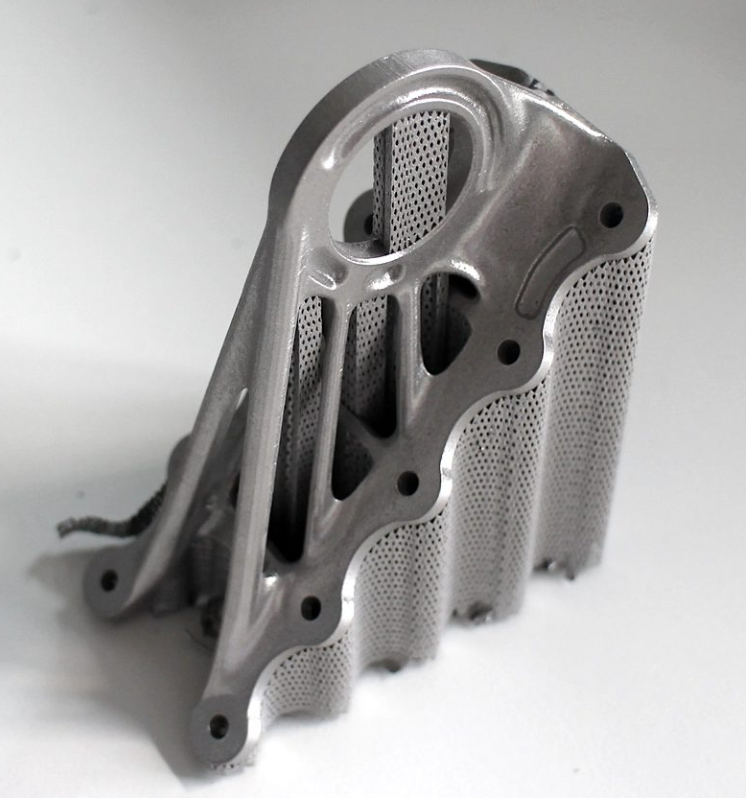
| Complex geometries | Internal channels, lattice structures, etc. are extremely difficult or impossible to machine | Can integrally produce complex internal features such as conformal cooling channels without subsequent assembly |
| Mold dependency | Batch production usually requires months to build a mold first | No mold required; parts are produced directly from digital files, ideal for low-volume, customized, or prototype validation |
| Design iteration | A design change may mean re-cutting a mold or adjusting the production line | Change the digital model and reprint directly; fast response |
4. When Is It Worth Using?
The advantages of 3D-printed steel are clear in specific scenarios: complex geometries, low volume, and avoiding high mold costs. Typical examples include mold inserts with conformal cooling channels, lightweight lattice structures, customized fixtures and tooling, and prototype validation with frequent design iterations.
Conversely, for simple shapes in high-volume production, traditional processes usually remain more advantageous in cost and efficiency. The choice depends on the geometric complexity of the part, the batch size, and the delivery timeline.

0086 0755 23170739
0086-0755-24325235
ciky@hainamould.com
Room 1605, 16th Floor, Hongyu Building, No. 495, Donghuan 2nd Road, Longhua Subdistrict, Longhua District, Shenzhen, Gongdong ,China 518109


Copyright 2026 Hainamould.com All rights reserved.
-
 0086 0755 23170739
-
 Facebook
-
 WhatsApp
-
 LinkedIn
-
 TOP