Company Blogs
In the mold and injection molding industry, the core function of PVD coating is: without changing the internal toughness of the mold steel, it greatly improves the surface hardness, wear resistance, and corrosion resistance of the mold, thereby extending mold life and improving product demolding.
I. How Is PVD Produced?
Imagine "raining down an extremely fine metal rain" inside a vacuum furnace:
·Place the mold into a high-vacuum furnace.
·Use high energy (such as an electric arc or electron beam) to bombard the target material (such as titanium or chromium).
·The target material is vaporized and reacts with the gas introduced into the furnace (such as nitrogen) to become titanium ions or nitrogen ions.
·Under the action of the electric field, these ions uniformly "slam" onto the mold surface and instantly solidify, forming an extremely thin, extremely hard, dense coating.
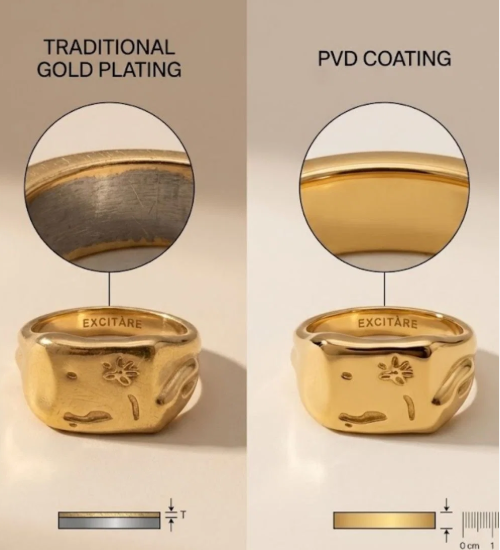
II. What Are the Most Commonly Used PVD Coatings in the Mold Industry?
·TiN (Titanium Nitride): The most classic "gold" color. High hardness, wear-resistant, commonly used for stamping dies and ordinary injection molds.
·TiAlN (Titanium Aluminum Nitride): Purplish-black/rainbow color. Excellent high-temperature resistance (oxidation resistance temperature can reach above 800°C), very suitable for the hot work molds mentioned earlier (such as die-casting molds and high-temperature injection molds).
·CrN (Chromium Nitride): Silver-gray. Extremely low friction coefficient, extremely strong anti-adhesion (anti-sticking) capability, commonly used for injection molds that require smooth demolding.
·DLC (Diamond-Like Carbon): Black. Extremely high hardness and extremely low friction coefficient, very suitable for processing highly wear-resistant materials (such as ABS or PC with 30% glass fiber, etc.), or optical parts requiring extremely high surface finish.
III. Advantages of PVD Compared with Traditional Treatments
·Compared with nitriding treatment (Nitriding): The customer previously requested the mold to be "Nitrided," which involves diffusing nitrogen atoms into the steel (chemical heat treatment) at a relatively high temperature (around 500°C), which may cause slight deformation of the mold. PVD, however, is surface coating; the treatment temperature is usually between 200°C and 500°C (some low-temperature PVD is even below 200°C), with minimal impact on the dimensions of high-precision molds (basically no deformation).
·Compared with electroplating (such as hard chrome plating): PVD is more environmentally friendly, and the coating adhesion is stronger, making it less prone to peeling off. PVD can even be coated deep into complex cavities (as long as the line of sight can "see" it, it can be coated).
How to Choose Commonly Used PVD Coatings for Injection Molds
Not all PVD is the same; choosing the wrong coating may waste money. Common selection logic is as follows:
| Coating Type | Core Features | Most Suitable Injection Molding Scenarios |
| CrN (Chromium Nitride) | Strong anti-adhesion, low friction coefficient, corrosion-resistant | General injection molds, deep-cavity parts requiring smooth demolding, plastics containing corrosive additives |
| TiAlN (Titanium Aluminum Nitride) | High hardness, high-temperature oxidation resistance | Glass fiber/carbon fiber reinforced materials (such as the customer's ABS+30%GF), high-temperature forming of engineering plastics |
| DLC (Diamond-Like Carbon) | Extremely low friction coefficient, wear-resistant | High-gloss surfaces, optical parts, highly sticky plastics (such as PET, PC), and precision parts requiring extremely low demolding force |
| TiN (Titanium Nitride) | General-purpose, cost-effective | General wear resistance and demolding protection for ordinary injection molds |
Data reference source: PVD coating hardness is usually 1200-2400 HV, far higher than the hardness of ordinary mold steel after quenching (about 600-800 HV), so it can effectively resist abrasive wear from glass fiber.

0086 0755 23170739
0086-0755-24325235
ciky@hainamould.com
Room 1605, 16th Floor, Hongyu Building, No. 495, Donghuan 2nd Road, Longhua Subdistrict, Longhua District, Shenzhen, Gongdong ,China 518109


Copyright 2026 Hainamould.com All rights reserved.
-
 0086 0755 23170739
-
 Facebook
-
 WhatsApp
-
 LinkedIn
-
 TOP